Steve Ballmer $162 billion was the figure Forbes published on 1 November 2026, placing the former Microsoft chief executive ninth among the world's richest people after his fortune rose by $1 billion during October. He was one of only two gainers in the top ten — the other was Warren Buffett — in a month when Microsoft shares inched up 2% while most of the world's richest people lost money.
Ballmer's story is unlike every other fortune on that list. He did not found Microsoft, inherit a fortune, or build a startup. He joined as employee number 30 in 1980, ran the company from 2000 to 2014, and simply kept most of his shares. That patience is the whole story — and it is why Steve Ballmer $162 billion is such a remarkable figure.
At a Glance
| Detail | Figure as reported |
|---|---|
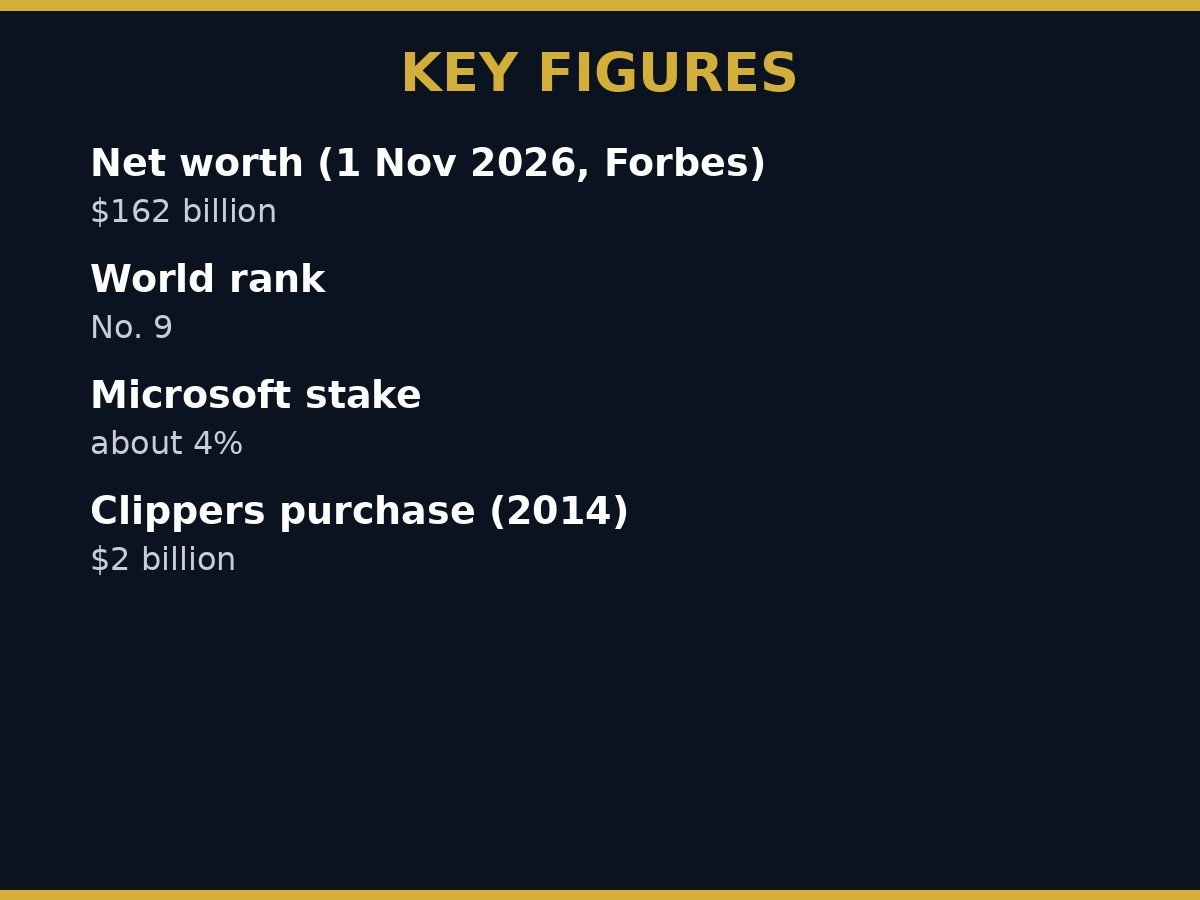
| Net worth (Forbes list, 1 Nov 2026) | $162 billion |
| World ranking | No. 9 |
| Change in October 2026 | Up $1 billion |
| Microsoft share move in October 2026 | Up 2% |
| Real-time fortune (10 Oct 2026, Forbes) | $165.0 billion, No. 9 |
| Real-time fortune (23 Nov 2026, Forbes) | About $154 billion |
| Estimated Microsoft stake | About 4%, roughly 333 million shares |
| Microsoft market value (Nov 2026) | About $3.7 trillion |
| LA Clippers purchase (2014) | $2 billion, then a record for an NBA team |
| Source | Forbes |
A Wild November: From $165 Billion to $154 Billion
The $162 billion figure on the 1 November list was only a snapshot, and November showed how quickly a fortune tied to a single stock can move. Forbes' real-time tracker had put Ballmer at $165.0 billion on 10 October 2026, still ninth, so the list figure already reflected a small cooling off. Then the month turned into a roller coaster.
Wednesday 4 November, the day after the United States midterm elections, was the high point: Ballmer added $8.8 billion in one day as Microsoft shares rose 7% to an all-time intraday high of $557.39, according to Forbes — one of the biggest one-day gains of his life, arriving without him doing anything at all.
The mood did not last. By 17 November, Forbes' real-time tracker had Ballmer at about $156 billion, ranked eighth. Two days later, on 19 November, Forbes reported him at $155.7 billion after Microsoft shares fell, and Warren Buffett passed him to take seventh place. The 1.6% decline in his fortune was linked to a 1.8% fall in Microsoft stock. By 23 November, the real-time figure had him at about $154 billion.
That is a swing of roughly $11 billion from the October peak to late November. Net worth estimates move daily, and the figures quoted here are dated snapshots from Forbes, not permanent totals — a single number without its date is misleading, because the real-time figure has already changed by the time a list is printed.
The Only Gainer Besides Buffett
October 2026 was a rough month for the world's richest people, which is what makes Ballmer's $1 billion gain stand out. He and Warren Buffett were the only gainers in the top ten, according to Forbes, while the other eight all lost money. A 2% rise in Microsoft shares was enough to put Ballmer on the right side of a brutal month.
The top ten is dominated by founders and heirs to family fortunes. Ballmer is neither. He is an employee who became a billionaire, then a centibillionaire, by holding shares in a company someone else founded. Bill Gates, the man who hired him, built Microsoft; Ballmer built his fortune by refusing to let go of his piece of it.
The comparison with Buffett is instructive. Buffett's fortune is spread across dozens of businesses inside Berkshire Hathaway, from insurance to railways to energy. Ballmer's fortune is, for practical purposes, one stock. When Microsoft rises, he rises; when it falls, he falls almost in lockstep. The 19 November figures prove the point: Microsoft down 1.8%, Ballmer down 1.6%. That is both the strength and the fragility of his position.
Employee Number 30 Who Never Sold
Steve Ballmer joined Microsoft in 1980 as employee number 30, hired by his former Harvard classmate Bill Gates to run the business side of a young software company. He was not a programmer or a founder; he was a salesman and an operations man who turned a clever software business into a commercial machine. He became chief executive in 2000 and held the job until 2014, steering Microsoft through the rise of the internet, the launch of the Xbox, and the long shift toward cloud computing.
Through all of that, he accumulated shares — and, crucially, he kept them. Ballmer owns about 4% of Microsoft, roughly 333 million shares, and he has said he is Microsoft's largest individual shareholder. That single fact explains almost everything about his net worth: Microsoft was worth about $3.7 trillion in November 2026, and a 4% slice of a company that size is a fortune beyond the reach of almost anyone alive.
The discipline involved should not be underestimated. Most executives sell large parts of their holdings along the way — to diversify, to buy houses, to fund foundations, or simply because their advisers tell them to. Ballmer sold some shares, but he kept the overwhelming bulk of his stake intact for more than four decades. Every time Microsoft doubled, his fortune doubled with it, because he never stepped off the ride.
The 2003 Sale He Probably Regrets
Ballmer did sell shares once, in a big way, and the numbers show how expensive that decision was. In 2003 he sold 39.3 million shares for about $955 million. At the time it looked like sensible diversification — nearly a billion dollars in cash is not a small sum, and Microsoft's shares were far from their current heights.
But time has been unkind to that sale. At the $557.39 intraday high Microsoft reached on 4 November 2026, those same 39.3 million shares would have been worth about $21.9 billion — more than twenty times what he received. That is simple arithmetic based on the reported share price, not a Forbes estimate, and it captures the cost of selling a compounding asset two decades too early.
Ballmer could not have known in 2003 that Microsoft would one day be worth about $3.7 trillion, or that cloud computing and artificial intelligence would drive its shares to record highs. But the episode shows why his remaining stake is so valuable: the shares he sold stopped working for him the moment the trade settled, while the shares he kept have multiplied many times over since.
The $2 Billion Clippers Bet
Ballmer's most famous purchase outside Microsoft came in 2014, when he bought the Los Angeles Clippers basketball team for $2 billion. At the time it was a record price for an NBA team, and many commentators thought he had overpaid. He had retired from Microsoft only months earlier, and the purchase looked like a rich man's hobby — a way to stay in the public eye after leaving the company he had run for fourteen years.
A decade later, the purchase looks very different. Sports franchises have soared in value as media rights deals have grown, and the Clippers play in the largest media market in the United States. The $2 billion tag that once looked extravagant now looks sharp, and it gives Ballmer an asset whose value does not depend on one company's share price.
The Clippers also show Ballmer is not simply a man sitting on a pile of shares. He is an owner and a public figure in his own right — the courtside regular whose enthusiasm became a meme, and the billionaire who chose to spend his retirement running a basketball team rather than retreating from public life. Unlike many billionaires who keep a low profile, Ballmer is impossible to miss.
Why One Stock Decides Everything
The defining feature of Ballmer's wealth is its concentration. His fortune is, to an unusual degree, a single bet on Microsoft, and the November figures show how that bet behaves. When Microsoft rose 7% on 4 November, Ballmer gained $8.8 billion in a day. When it fell 1.8% on 19 November, he lost 1.6% of his fortune. The correlation is almost perfect: his ranking is decided in the stock market every trading day.
That concentration cuts both ways. In a rising market, few billionaires can add nearly $9 billion in a single session. In a falling market, a routine 10% correction in Microsoft shares would cost him roughly $15 billion on paper. That is the price of holding a 4% stake in a $3.7 trillion company: the numbers are enormous in both directions.
Other billionaires have the same exposure: Larry Ellison is tied to Oracle, Mark Zuckerberg to Meta, and Jeff Bezos to Amazon. But Ballmer's case is purer, because he did not found the company that made him rich. Founders hold their shares because they built the business; Ballmer holds his because he chose, year after year, not to sell. That choice, repeated for more than forty years, is the entire explanation for Steve Ballmer $162 billion.
What Could Move Ballmer's Fortune Next
Looking ahead, Ballmer's ranking will be decided by Microsoft's share price. The company's cloud business and its push into artificial intelligence have driven the stock to record highs, and any change in how investors view those businesses will show up in his net worth within hours. A strong earnings report could add billions; a weak one could take billions away, just as November demonstrated.
The Clippers, whose value has grown far beyond the $2 billion he paid in 2014, and whatever else he holds outside Microsoft, are rounding errors next to a stake worth well over $100 billion. For practical purposes, the story of Ballmer's fortune is the story of Microsoft's share price — and it will stay that way unless he sells a large part of his holding, something he has shown no inclination to do. Follow the moving figure on the Forbes Real-Time Billionaires list or the Bloomberg Billionaires Index.
The broader lesson is simple, and it is why Ballmer's story resonates beyond the rich lists. He did not invent a product, found a company, or inherit a fortune. He joined a good company early, worked there for decades, and held on to his shares while it grew into one of the most valuable businesses in history. It is the least glamorous path to $162 billion ever taken — and one of the most effective.
Frequently Asked Questions
How much is Steve Ballmer worth?
Steve Ballmer $162 billion was the figure Forbes published on its list dated 1 November 2026, ranking him ninth in the world. His real-time fortune moves daily with Microsoft's share price — Forbes had it at $165.0 billion on 10 October 2026 and about $154 billion on 23 November 2026 — so any single figure is a dated snapshot. Net worth estimates move every trading day.
How did Steve Ballmer make his money?
Ballmer joined Microsoft in 1980 as employee number 30 and served as chief executive from 2000 to 2014. He built his fortune by accumulating Microsoft shares over four decades and keeping most of them. He owns about 4% of the company, roughly 333 million shares, and has said he is Microsoft's largest individual shareholder. He also bought the LA Clippers for $2 billion in 2014.
Does Steve Ballmer still own Microsoft shares?
Yes. Ballmer owns about 4% of Microsoft, roughly 333 million shares, and has said he is the company's largest individual shareholder. That stake is the overwhelming source of his wealth, which is why his net worth moves almost in lockstep with the share price — up $8.8 billion on 4 November 2026 when the shares rose 7%, and down 1.6% on 19 November when they fell 1.8%.
What is Steve Ballmer's biggest asset besides Microsoft?
His best-known asset outside Microsoft is the LA Clippers, bought in 2014 for $2 billion — a record price for an NBA team at the time. The purchase gave him a major asset whose value does not depend on Microsoft's share price, and sports franchises have risen sharply in value since then. His Microsoft stake, however, remains vastly larger than everything else he owns combined.