Warren Buffett passes Larry Ellison. On 27 November 2026, the 96-year-old investor, worth $159.8 billion, moved past Oracle's Larry Ellison to rank seventh among the world's billionaires, according to Forbes real-time data. It was a quiet upset: no dramatic event, no sudden windfall, just the slow arithmetic of a value investor climbing while the artificial intelligence fortunes around him fell. Buffett's rise and Ellison's slide tell the story of November in a single swap, and they say a lot about where money has been hiding from the tech sell-off.
At a Glance
| Person | Fortune | Rank | Source and date |
|---|---|---|---|
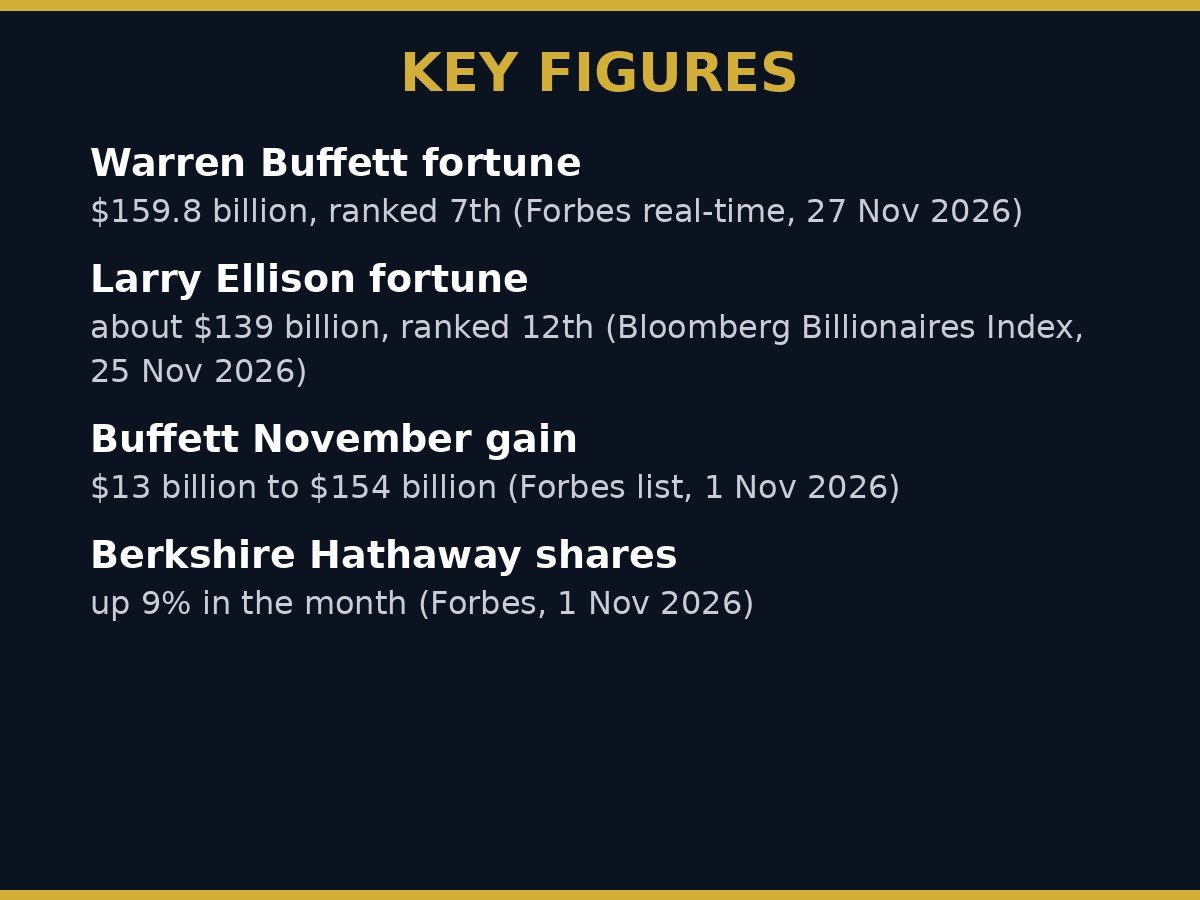
| Warren Buffett | $159.8 billion | 7th | Forbes real-time, 27 Nov 2026 |
| Warren Buffett | $154 billion, up $13 billion in the month | 10th | Forbes list, 1 Nov 2026 |
| Larry Ellison | $172 billion | 8th | Forbes list, 1 Nov 2026 |
| Larry Ellison | About $139 billion | 12th | Bloomberg Billionaires Index, 25 Nov 2026 |
| Berkshire Hathaway shares | Up 9% in the month | — | Forbes, 1 Nov 2026 |
The Rank Swap That Summed Up November
Rankings on the billionaire list move every day, but some moves mean more than others. When Warren Buffett passes Larry Ellison, it is not just two names changing places. It is two opposite ideas about wealth changing places: the patient value investor who buys businesses and holds them for decades, and the technology founder whose fortune rides on a single company's share price and the market's faith in artificial intelligence. On 27 November 2026, the patient idea won the day, with Buffett at $159.8 billion and ranked seventh.
The swap was the product of a month in which the two men's fortunes moved in opposite directions. On the Forbes list dated 1 November 2026, Ellison stood at $172 billion and ranked eighth, while Buffett stood at $154 billion and ranked tenth — a gap of $18 billion in Ellison's favour. By 27 November, the lead was gone, and Buffett had moved past him into seventh place.
What changed was the market repricing two very different kinds of wealth. Ellison's fortune is tied closely to Oracle, whose shares fell hard as investors questioned AI spending and debt. Buffett's fortune is tied to Berkshire Hathaway, whose shares climbed 9% in the month. One fortune fell with the tech sell-off, the other rose above it. For the latest standings, see the Forbes billionaires list and the Bloomberg Billionaires Index. All figures here are estimates from Forbes real-time data and the Bloomberg Billionaires Index, dated as stated, and they move daily with share prices.
Buffett's November: Up $13 Billion While Others Fell
Buffett's November was remarkable not for its size alone, but for its direction. On the Forbes list dated 1 November 2026, he was worth $154 billion, up $13 billion in the month, and ranked tenth. He and Steve Ballmer were the only gainers in the top ten that month. In a month when the world's richest technology founders were shedding tens of billions, the 96-year-old from Omaha was one of only two people at the top who actually got richer.
The reason was Berkshire Hathaway. The company's shares climbed 9% in the month, and that steady rise lifted Buffett's fortune while others fell. There was no single spectacular announcement behind it — just a conglomerate doing what it has done for decades: owning insurance, railroads, energy, and big stakes in public companies, and compounding value slowly. In a month defined by doubts about AI spending, that steadiness looked less like dullness and more like shelter.
The $13 billion monthly gain is worth setting against the losses around it. While technology founders were losing $20 billion in a day, or $159 billion in a year, Buffett added $13 billion in a month by doing very little that was new. In a falling market, not losing money is its own kind of outperformance, and a fortune built on cash-generating businesses behaves differently from one built on a single soaring share price. See our earlier report on Warren Buffett gaining $13 billion in November 2026.
Ellison's Slide in Brief
Ellison's side of the story is shorter here on purpose, because a separate post has already covered his year in depth, and this article is about the rank swap rather than a retelling of that fall. The outline is stark enough on its own. Ellison has lost about $159 billion in a year, according to Bloomberg in early November 2026, as Oracle shares fell on AI-spending and debt worries. That is one of the largest fortunes ever lost in such a short period, and it is the reason a man who was once chasing the very top of the list found himself sliding down it instead.
The November details fill in the picture. On the Forbes list dated 1 November 2026, Ellison stood at $172 billion and ranked eighth. After the market slide of 20 November, his fortune was about $139 billion, ranked twelfth, according to the Bloomberg Billionaires Index dated 25 November 2026. Then, on Wednesday 25 November, his fortune shed another $9.6 billion as Oracle stock fell 8%, dropping him from eleventh to thirteenth — three snapshots, all pointing down.
The cause is the same worry that drove the wider sell-off: investors questioning whether heavy AI spending, much of it funded by debt, will produce meaningful profits. Oracle sits at the centre of that question, because its recent rise was built on its role in the AI build-out, and its debt-funded expansion is exactly the kind of spending investors have grown nervous about. When the market doubts the spending, Oracle's shares fall, and Ellison's fortune falls with them. For the full account of the year's losses, see our in-depth report on Larry Ellison losing $159 billion in a year.
Berkshire's 9% Month and Where Money Is Hiding
Berkshire Hathaway's 9% rise in the month is the quiet engine behind Buffett's climb, and it explains what kind of wealth holds up when technology shares fall. Berkshire is not a single bet on a single idea: it owns insurance businesses, railroads, energy companies, and big stakes in public companies, and that diversity is its defence. When one part of the economy struggles, another can carry the weight.
That steadiness is the opposite of the AI trade. The technology fortunes that fell hardest in November were concentrated: a huge share of one person's wealth tied to one company's shares, which were in turn tied to one big idea about the future. When the market doubted that idea, even briefly, the fortune fell by tens of billions in a day. Berkshire's wealth is spread across businesses that earn money in the present, from premiums and freight and power, and that spread makes it harder for a single doubt to do the same damage.
There is a broader lesson about where money hides during a sell-off. Nervous investors do not simply hold cash and wait; they move toward businesses with steady earnings, strong balance sheets, and a record of surviving downturns. Berkshire is the most famous example, and its 9% monthly rise suggests plenty of investors made exactly that move in November. Buffett simply had to own the kind of company that frightened money runs toward. The contrast with the sell-off tracked in our report on tech billionaires losing $273 billion in November could hardly be sharper; market coverage of the rotation can be followed on CNBC and Reuters.
Buffett Also Passed Ballmer, the Tortoise and the Hare
The Ellison swap was not Buffett's first overtake of the month. On 19 November, Buffett also passed Steve Ballmer for seventh place, worth $155.7 billion at the time, as Microsoft shares slipped. That earlier move shows the Ellison swap was part of a pattern rather than a one-off event: Buffett was climbing past one technology fortune after another, not because his wealth was surging, but because theirs was slipping while his held firm and rose gently. Seventh place changed hands more than once in a single month, and a gap that looks solid on one day can close within a week when daily moves are measured in billions. For more on Ballmer's fortune, see our profile of Steve Ballmer's net worth.
The angle that has captured the most attention is the simplest one: the tortoise passing the hare. Buffett is 96 years old, a value investor who took control of Berkshire Hathaway, then a struggling textile company, in 1965, and turned it into a conglomerate owning insurance, railroads, energy, and big stakes in public companies. He has pledged to give away almost all of his fortune. Ellison is the Oracle founder whose fortune soared on the AI boom and then fell just as fast when the market questioned that boom. One built wealth slowly over six decades; the other built it quickly on a single powerful idea, and watched a large part of it disappear in a year. The day Warren Buffett passes Larry Ellison is the day that slow building overtook fast building, at least for now.
What the Swap Means — and What It Does Not
The rank swap means that, as of 27 November 2026 — the day Warren Buffett passes Larry Ellison — Buffett is the seventh-richest person in the world, worth $159.8 billion, and Larry Ellison sits below him. It means that a month of steady gains beat a month of sharp losses, and that Berkshire's 9% rise was worth more, in ranking terms, than Oracle's slide cost. Those are facts, dated and sourced, and they are worth recording plainly.
What it does not mean is that Buffett has won some final contest, or that value investing has defeated technology investing for good. Rankings are snapshots: Ellison's fortune has swung by tens of billions in both directions before, and a bad month for Berkshire could reverse the order just as quickly. The durable lesson is the one Buffett has taught for sixty years: wealth built slowly, on businesses that earn money in the present, is harder to lose in a hurry than wealth built quickly on expectations about the future. For background, see our profiles of Warren Buffett's net worth and Larry Ellison's net worth.
Frequently Asked Questions
When did Warren Buffett pass Larry Ellison?
On 27 November 2026, Warren Buffett, worth $159.8 billion, passed Oracle's Larry Ellison to rank seventh among the world's billionaires, according to Forbes real-time data. Buffett had already passed Steve Ballmer for seventh place on 19 November, worth $155.7 billion at the time, as Microsoft shares slipped.
How much was Buffett worth, and how much had he gained in November?
On the Forbes list dated 1 November 2026, Buffett was worth $154 billion, up $13 billion in the month, and ranked tenth. He and Steve Ballmer were the only gainers in the top ten that month, while Berkshire Hathaway shares climbed 9%. By 27 November, Forbes real-time data put him at $159.8 billion and ranked seventh.
Why did Larry Ellison fall behind Buffett?
Ellison's fortune is tied closely to Oracle, whose shares fell as investors worried that heavy AI spending, much of it funded by debt, may not produce meaningful profits. He has lost about $159 billion in a year, according to Bloomberg in early November 2026, and his fortune fell to about $139 billion, ranked twelfth, after the 20 November slide, according to the Bloomberg Billionaires Index dated 25 November 2026.
What is Warren Buffett's background, and what has he pledged to do with his fortune?
Buffett took control of Berkshire Hathaway, then a struggling textile company, in 1965, and turned it into a conglomerate owning insurance, railroads, energy, and big stakes in public companies. He has pledged to give away almost all of his fortune.