Mark Zuckerberg loses $40 billion in November 2026, with Meta shares falling 15% over the month and his fortune dropping to $211 billion on the Forbes list published on 1 November 2026. The decline makes him one of the biggest losers among the world's richest people in a brutal month for technology stocks, and it comes with a bitter irony at its centre: the same AI spending that is meant to secure Meta's future is what keeps cutting his fortune.
Zuckerberg owns about 13% of Meta, the company he co-founded as Facebook at Harvard in 2004 and took public in 2012. That stake is the overwhelming source of his wealth, so his fortune moves almost exactly with the Meta share price. When investors worry about what Meta is spending on artificial intelligence, the shares fall, and billions disappear from his estimated net worth in a matter of hours. November 2026 gave investors plenty to worry about.
At a Glance
| Detail | Figure as reported |
|---|---|
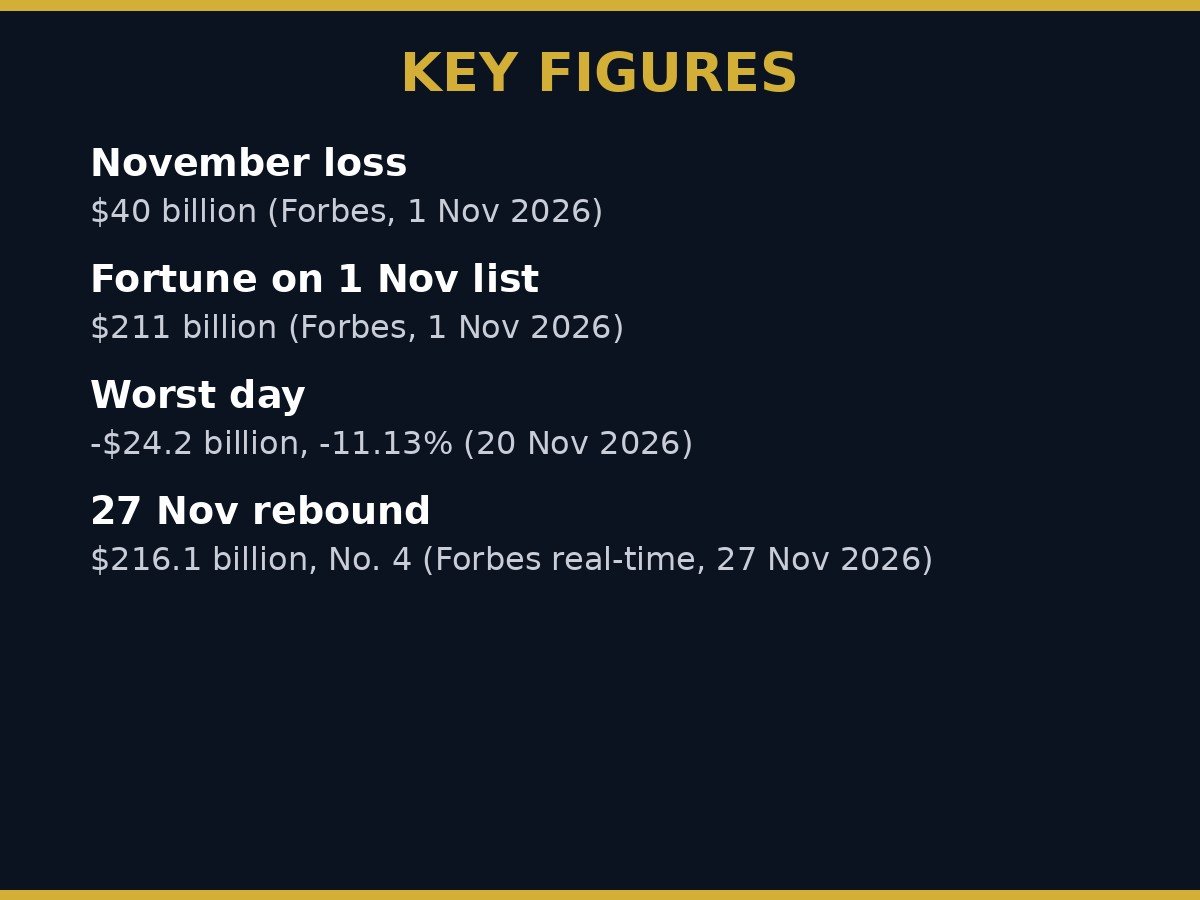
| Loss in November 2026 | About $40 billion (Forbes, 1 November 2026 list) |
| Fortune on the 1 November list | $211 billion |
| Meta shares in November | Down 15% over the month |
| Loss on Friday 20 November | $24.2 billion in one day (-11.13%) |
| Fortune after 20 November | $193.1 billion |
| Market fall on 20 November | Nasdaq down 5.3%; S&P 500 down 3.7% to a seven-month low |
| Loss on 5 November | $8.4 billion in a day (Bloomberg) to about $208 billion |
| Gain on Wednesday 4 November | About $3 billion as Meta rose 1.5% |
| Fortune on 27 November | $216.1 billion, after a $6.5 billion gain; back to No. 4 (Forbes real-time) |
| Zuckerberg's Meta stake | About 13% of the company |
How Mark Zuckerberg Loses $40 Billion in a Month
The scale of the loss is easier to understand once the mechanism is clear. Mark Zuckerberg owns about 13% of Meta, so every 1% fall in the Meta share price wipes roughly $1.5 billion or more off his fortune at the company's current size. A 15% fall over a month, which is what Meta suffered in November 2026, therefore costs him tens of billions of dollars without him selling a single share or the underlying business changing at all. The fortune is a live estimate of what his stake is worth at the latest share price, and it is recalculated every time that price moves.
That story is not really about Zuckerberg at all. It is about a market that has fallen out of love with the AI spending spree, and about a company that is one of the biggest spenders in the world. Meta is pouring tens of billions of dollars into data centres, chips and AI talent, and investors spent November asking a question that has no comfortable answer: when does all of this spending start paying for itself?
The $24.2 Billion Day: Friday 20 November
The worst day of the month, and one of the worst days of Zuckerberg's financial life, came on Friday 20 November 2026. He lost $24.2 billion in a single day, a fall of 11.13%, taking his fortune to $193.1 billion. It was the steepest percentage hit among the top five richest people that day, and the largest loss on Forbes' real-time list. The trigger was a broad market rout: the Nasdaq fell 5.3% and the S&P 500 fell 3.7% to a seven-month low, as investors sold technology shares across the board, in a sell-off covered by Reuters.
Meta fell about 4% that Friday, but the damage to Zuckerberg's fortune was far larger than 4% of his wealth would suggest, because the day's fall came on top of weeks of earlier declines. The 11.13% drop in his estimated fortune reflects the market's judgement on Meta's spending plans as much as the single day's trading, with investors marking down the value of his stake to reflect a future in which Meta's AI bet takes longer to pay off, or pays off less, than the company hopes.
The Goldman Sachs Warning That Spooked the Market
One report did more than any other to turn the market against the AI hyperscalers in November. Goldman Sachs warned that AI hyperscalers including Meta need roughly $300 billion a year in AI services revenue just to break even on their capital spending, and $1 trillion a year to earn meaningful profits. The numbers were staggering, and they landed in a market that was already nervous about how much Meta, Amazon, Alphabet and Microsoft were spending on data centres and chips.
The logic of the warning is simple, and it is what frightened investors. If Meta must generate $300 billion a year from AI services merely to cover what it spends building the infrastructure, then the current pace of spending implies years of heavy investment before the returns arrive. And $1 trillion a year, the figure Goldman Sachs put on earning meaningful profits, is more than the entire revenue of most of the world's largest companies. Investors did the maths, looked at Meta's spending plans, and decided the risk was too great. On the Friday the warning circulated, Meta fell about 4%, and Zuckerberg's loss was the largest on Forbes' real-time list that day.
The Midterm Whiplash: Up $3 Billion, Then Down $8.4 Billion
November began with a whiplash that captured the whole month in miniature. On Wednesday 4 November, Zuckerberg gained about $3 billion as Meta rose 1.5% in the post-midterm relief rally, with investors deciding that the Democrats' sweep of the 3 November elections removed uncertainty rather than adding to it. The next day, the mood reversed completely. On 5 November, Zuckerberg lost $8.4 billion in a day, according to Bloomberg, falling to about $208 billion as Meta dropped 4% after the midterm results raised fears of an AI slowdown.
The two days, taken together, are a lesson in how fast sentiment can turn when a fortune is tied to a single stock. A $3 billion gain on Wednesday became an $8.4 billion loss on Thursday, and the net result was a fortune more than $5 billion lower than it had been two days earlier, with nothing at Meta itself having changed. The company announced no results, changed no guidance and launched no product in those 48 hours. The market simply changed its mind about what the election meant for AI spending, and Zuckerberg's estimated wealth changed with it.
The 27 November Rebound and the Race for No. 4
The month did not end at its lowest point. On 27 November, Zuckerberg gained $6.5 billion to $216.1 billion and passed Sergey Brin for the No. 4 spot on Forbes' real-time list. The rebound showed that even in a month defined by losses, a single good day can restore billions. One week earlier, his fortune had stood at $193.1 billion after the 20 November rout. Ten days later, it was more than $20 billion higher, without Meta having reported anything new.
The recovery also shows why every figure in this article must be read with its date attached. The $211 billion figure belongs to the Forbes list published on 1 November 2026, the $193.1 billion figure to 20 November, and the $216.1 billion figure to 27 November. All three are accurate for their moment, and none is the final word on what Mark Zuckerberg is worth, because these estimates are based on live share prices and change every trading day. It is a useful reminder that Mark Zuckerberg loses $40 billion in a month when the market turns against Meta's spending, yet can win back more than $20 billion of it in a single week.
The race for fourth place is worth watching precisely because it is so volatile. Zuckerberg, Brin and the other founders clustered near the top of the list trade places whenever their companies' shares move in different directions, and November gave the market plenty of reasons to move them. Whether Zuckerberg holds No. 4 depends on the same thing it has always depended on: the Meta share price, and the market's faith in the AI spending that drives it.
Why Meta's AI Spending Worries Investors
The worry about Meta's spending is not abstract. The company is committing tens of billions of dollars a year to data centres, custom chips and AI research, and the returns on that spending are uncertain and distant. That asymmetry is what Goldman Sachs put a number on, and it is what the market spent November repricing.
There is a genuine debate underneath the fear. Meta's leadership argues that AI is the foundation of the company's next decade, powering everything from advertising to the virtual reality headsets and smart glasses it hopes will become the next computing platform. From that point of view, underinvesting would be the real risk, because a company that falls behind in AI may never catch up. The spending is not a luxury. It is the cost of staying relevant.
Zuckerberg's Stake and the Long Game
Through all of this, one fact has not changed: Zuckerberg still owns about 13% of Meta, and he still controls the company he co-founded at Harvard in 2004 and took public in 2012. The $40 billion loss has not cost him his company, his voting control or his ability to set its strategy. It has cost him paper wealth, and paper wealth is precisely the kind of wealth that returns when the share price recovers, as the 27 November rebound showed.
That control is both his strength and his vulnerability. Because he controls Meta, he can keep spending on AI even when the market hates it, without facing the shareholder revolt that might force another chief executive to cut back. Because his fortune is concentrated in Meta, he also bears the full cost of that decision in his own net worth. The November loss is the price of a strategy that only he can set, and only he can change. If the AI bet pays off, the $40 billion will look like a footnote. If it does not, it will look like the first instalment of a much larger bill.
The comparison with his peers is instructive. Elon Musk also lost heavily in November, and the technology sector as a whole lost $273 billion in the month, so Zuckerberg's loss is part of a broader rout rather than a verdict on Meta alone. But Meta fell further than most of its rivals, and the reason is specific to Meta: the market believes its AI spending is the largest and the least certain to pay off quickly. Until that belief changes, Zuckerberg's fortune will remain the most sensitive barometer of the AI spending debate.
Frequently Asked Questions
How much did Mark Zuckerberg lose in November 2026?
Mark Zuckerberg loses $40 billion in November 2026, according to the Forbes list published on 1 November 2026, which put his fortune at $211 billion. Meta shares fell 15% over the month, and his loss reflects that decline applied to his roughly 13% stake in the company. All billionaire net worth figures are dated estimates based on live share prices, not fixed amounts, and they change every trading day.
What happened on 20 November 2026?
On Friday 20 November 2026, Zuckerberg lost $24.2 billion in a single day, a fall of 11.13%, taking his fortune to $193.1 billion. It was the steepest percentage hit among the top five richest people that day. The Nasdaq fell 5.3% and the S&P 500 fell 3.7% to a seven-month low, as investors sold technology shares across the board and Meta fell about 4%.
Why are investors worried about Meta's AI spending?
Goldman Sachs warned that AI hyperscalers including Meta need roughly $300 billion a year in AI services revenue just to break even on their capital spending, and $1 trillion a year to earn meaningful profits. Investors worry that Meta's enormous spending on data centres, chips and AI talent will take years to pay off, if it ever does. The same spending is meant to secure Meta's future, which is why the debate is so difficult for the market to resolve.
Did Zuckerberg recover any of the loss?
Yes. On 27 November 2026, Zuckerberg gained $6.5 billion to $216.1 billion and passed Sergey Brin for the No. 4 spot on Forbes' real-time list. The rebound shows how quickly these estimates move: his fortune stood at $193.1 billion on 20 November and was more than $20 billion higher a week later, without Meta having reported anything new in between.