Larry Page and Sergey Brin lose $102 billion in November 2026, after Alphabet shares fell more than 18 percent over the month and a single bad earnings day wiped out around $60 billion of their combined fortune. Page lost $53 billion in the month and Brin lost $49 billion, according to the Forbes list published on 1 November, and the slide left them still ranked among the five richest people on the planet. It is a reminder that even the founders of the world's most powerful search company can lose a fortune in weeks.
At a Glance
| Detail | Figure |
|---|---|
| Page net worth, 1 November 2026 | $233 billion (Forbes), down $53 billion in the month |
| Brin net worth, 1 November 2026 | $214 billion (Forbes), down $49 billion in the month |
| Combined November loss | About $102 billion |
| Alphabet fall over the month | More than 18% |
| Alphabet fall on 29 October 2026 | More than 12% in one day ($321.89 to $283.29) |
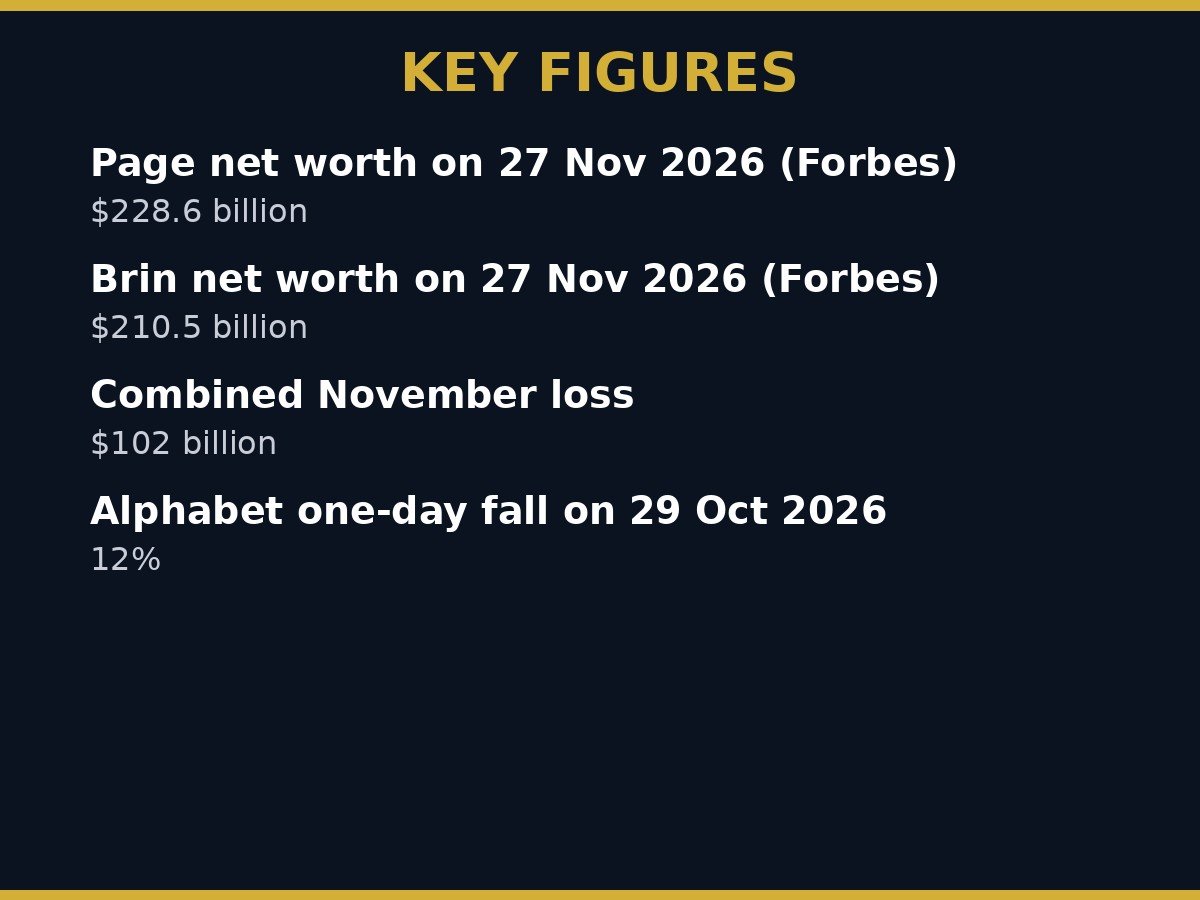
| Page net worth, 27 November 2026 | $228.6 billion (Forbes, real-time) |
| Brin net worth, 27 November 2026 | $210.5 billion (Forbes, real-time) |

One stock, one month, $102 billion gone
Larry Page and Sergey Brin lose $102 billion in November, and the reason is almost comically simple: they both own the same stock, and that stock had a terrible month. Page and Brin each own about three percent of Alphabet, the parent company of Google, and they are its largest individual shareholders. When Alphabet falls, they fall with it, and when Alphabet falls by more than 18 percent in a month, the damage runs into tens of billions of dollars for each of them.
The Forbes list published on 1 November captured the damage. Page was valued at $233 billion, down $53 billion in the month, while Brin was valued at $214 billion, down $49 billion. The two figures add up to about $102 billion, a sum larger than the entire fortune of almost every other billionaire on the planet. It is the kind of loss that would end most fortunes outright, yet for Page and Brin it was a bad month rather than a catastrophe.
The real-time Forbes tracker on 27 November showed Page at $228.6 billion and Brin at $210.5 billion, a little below the 1 November figures, which suggests the bleeding had slowed but not reversed. Alphabet shares were down about 10 percent for the year to date as of 29 October, a striking reversal for a company that spent years as one of the stock market's most reliable performers.
The day Alphabet lost more than $500 billion
The worst of the damage came on a single day. On 29 October 2026, Alphabet plunged more than 12 percent, falling from $321.89 to $283.29, in its worst day since the company went public in 2004. More than $500 billion was wiped from Alphabet's market value in under 24 hours, an amount greater than the value of most companies in the world. Page lost about $31 billion that morning, according to Forbes, and Brin lost about $29 billion, a combined fall of roughly $60 billion before lunch.
A 12 percent fall in a company the size of Alphabet is rare, and it happens only when investors change their minds about something fundamental. Alphabet is not a small, speculative business. It owns Google Search, YouTube, Android, and Google Cloud, and it earns more money in a quarter than most countries. For its shares to fall by an eighth in a day, the market must have decided that the company's future is materially worse than it believed the day before. The trigger was the quarterly earnings report: numbers that were good but not good enough, and a spending figure that frightened investors.
What the earnings report actually said
Alphabet's third-quarter results looked strong at first glance: revenue reached $127.6 billion, but slightly below forecasts, and a small miss can be expensive. Search revenue rose 12 percent to $63.4 billion, which sounds healthy until you compare it with the roughly 15 percent growth analysts had expected. A three-point gap in the growth of the company's most important business was enough to worry investors.
Google Cloud provided the brightest spot: its revenue more than doubled to $30.7 billion. But even that good news was overshadowed by what the company spent to achieve it. Capital expenditure reached $51.4 billion in the quarter, about 40 percent of revenue, mostly on artificial intelligence projects. Investors saw a company spending at an extraordinary rate and asked whether the returns would ever match the outlay.
The spending figure is the key to understanding the sell-off. Alphabet is pouring money into data centres, chips, and AI research, competing with Microsoft, Amazon, and Meta in a race that has no clear finish line. When a company spends 40 cents of every dollar it earns on building for the future, investors want evidence that the future will pay. On 29 October, they decided they had not seen enough of it.
Why the founders are still No. 3 and No. 5
Losing $102 billion in a month sounds like ruin, but Page and Brin remain the third and fifth richest people in the world. The reason is simple arithmetic: they started the month with so much wealth that even a loss of this size leaves them far ahead of almost everyone else. Page at $233 billion and Brin at $214 billion are still richer than all but a handful of people on the planet.
Their staying power also reflects the structure of their wealth. Together, Page and Brin hold a majority voting share in Alphabet, which means they control the company even though each of them owns only about three percent of its shares. That control matters because it lets them take a long-term view. They do not need to worry about being pushed out by unhappy shareholders, and they can keep spending on artificial intelligence even when the market punishes them for it.
Their voting power is the reason they can afford to lose $102 billion in a month without losing their company. Even after the fall, Alphabet still owns the world's dominant search engine, the largest video platform, the most widely used mobile operating system, and a cloud business that just doubled its revenue, so three percent of it remains one of the great fortunes in history.
The concentration risk nobody talks about
The story of Page and Brin is also a lesson in concentration. Their fortunes depend almost entirely on a single company, and their wealth rises and falls with a single share price. Diversification is the first rule of personal finance for ordinary investors, but the world's richest people routinely ignore it. They built their fortunes by holding on to the companies they founded, and they keep holding on because selling would mean giving up control and paying enormous taxes.
That concentration cuts both ways. When Alphabet was rising, Page and Brin gained billions without lifting a finger, and Brin's fortune had climbed sharply through much of the year as Alphabet shares rose. The same mechanism works in reverse, and November showed how quickly it can work. A fall of more than 18 percent in a month translates directly into tens of billions of dollars lost, because there is no other asset in their portfolios large enough to cushion the blow. Other billionaires face the same risk: Larry Ellison lost $159 billion in a year when Oracle shares fell, and Michael Dell lost $68 billion in November for similar reasons. The pattern is the same every time: one company, one share price, and a fortune that moves with it.
For a broader view of the month's damage, see our report on tech billionaires losing $273 billion in November, and for the longer view of the founders' wealth, see Larry Page's net worth and Sergey Brin's net worth. For the latest rankings, see the Forbes real-time billionaires list, the Bloomberg Billionaires Index, Reuters, and CNBC.

Can Alphabet win the AI race?
The deeper question is whether Alphabet can win the artificial intelligence race it is spending so much to enter. Google invented much of the technology behind modern AI, including the transformer architecture that powers today's chatbots, yet it has spent the last two years playing catch-up in public perception. Investors worry that Google's search business, which earns more than $63 billion a quarter, could be disrupted by chatbots that answer questions directly instead of showing links.
Alphabet's answer is to spend its way through the problem. The $51.4 billion in capital expenditure in a single quarter is the clearest sign of that strategy. The money is going into data centres, custom chips, and the computing power needed to train and run large AI models. The company is betting that its scale, its data, and its distribution through Search, Android, and YouTube will eventually win out. It is a reasonable bet, but it is an expensive one, and the market's reaction in October showed that investors are no longer willing to take it on faith. Cloud is where the AI race is being fought commercially, and Google Cloud revenue more than doubling to $30.7 billion suggests customers are buying Alphabet's AI services in large numbers, though the business is still smaller than Search.
What comes next for Page and Brin
The immediate outlook depends on Alphabet's next earnings report and on whether the AI spending starts to show clearer returns. If Cloud keeps doubling and Search growth recovers toward the 15 percent analysts expect, the shares could recover much of November's loss, and Page and Brin would regain tens of billions just as quickly as they lost them.
If the spending keeps rising without a matching return, the pressure will grow, and another quarter like the last one could push the shares lower still. Page and Brin can afford to wait, because their voting control means nobody can force them to change course, but the market's patience is not unlimited. For now, Larry Page and Sergey Brin lose $102 billion in November stands as one of the biggest monthly losses ever recorded for two people, and it is a reminder that even the founders of the world's most successful search company are not immune to the market's moods. One stock, one earnings report, and $102 billion gone.
Frequently Asked Questions
How much did Larry Page and Sergey Brin lose in November?
Larry Page and Sergey Brin lose $102 billion in November 2026 combined, according to the Forbes list published on 1 November. Page lost $53 billion in the month, falling to $233 billion, while Brin lost $49 billion, falling to $214 billion. Forbes' real-time tracker on 27 November put Page at $228.6 billion and Brin at $210.5 billion. All figures are estimates and move daily with Alphabet's share price.
What caused Alphabet shares to fall so sharply?
Alphabet shares fell more than 18 percent over the month, including a plunge of more than 12 percent on 29 October 2026, from $321.89 to $283.29, the worst day since the company went public in 2004. The trigger was a third-quarter earnings report in which revenue of $127.6 billion slightly missed forecasts, Search grew 12 percent instead of the expected 15 percent, and capital expenditure hit $51.4 billion, about 40 percent of revenue, mostly on AI projects.
Why are Page and Brin still among the richest people in the world?
Despite the loss, Page and Brin remain No. 3 and No. 5 among the world's richest people, because they started from such extraordinary wealth. Each owns about three percent of Alphabet as its largest individual shareholders, and together they hold a majority voting share, giving them control of the company. Even a reduced stake is worth more than $200 billion each.
Will Page and Brin recover the $102 billion?
Recovery depends on Alphabet's share price, which depends on its next earnings and on whether its heavy AI spending starts to show clearer returns. Google Cloud revenue more than doubled to $30.7 billion, which is encouraging, but Search growth and the $51.4 billion quarterly spending bill remain concerns. A strong quarter could restore tens of billions quickly, while another disappointment could extend the losses.