The five richest lose $146 billion in a single day. That is the blunt verdict from Forbes real-time data for Friday, 20 November 2026, when the world's wealthiest people shed a combined $146 billion as American stocks tumbled on fears about artificial intelligence spending. Elon Musk alone accounted for more than half of the damage, losing $73.8 billion in one session, while Mark Zuckerberg suffered the steepest percentage fall among the top five. It was one of the sharpest single-day sell-offs of the year, and it showed how quickly paper fortunes can evaporate when the market's favourite trade turns against it.
At a Glance
| Person | One-day change | Fortune after the drop | Source and date |
|---|---|---|---|
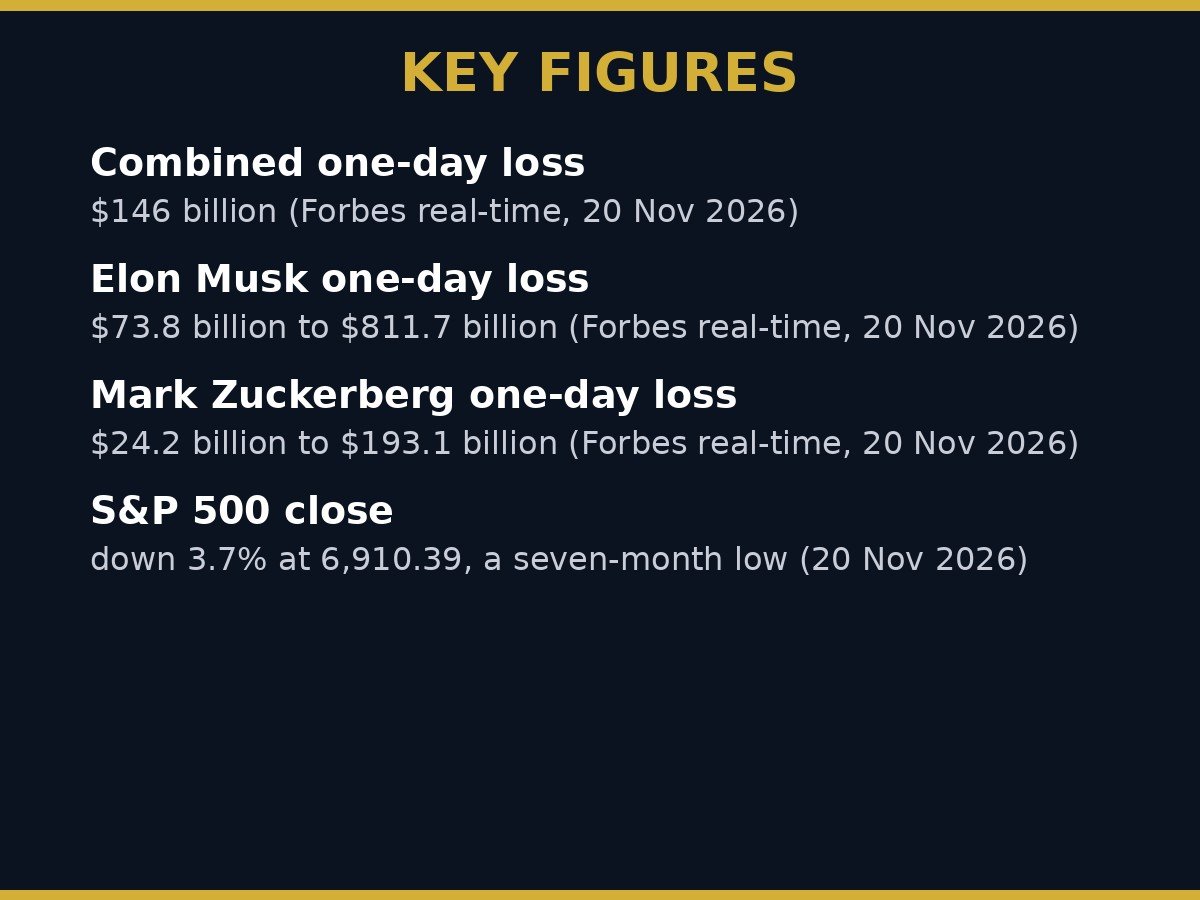
| Elon Musk | -$73.8 billion (-8.34%) | $811.7 billion | Forbes real-time, 20 Nov 2026 |
| Mark Zuckerberg | -$24.2 billion (-11.13%) | $193.1 billion | Forbes real-time, 20 Nov 2026 |
| Michael Dell (6th) | Not stated in the day's figures | $181.8 billion | Forbes real-time, 20 Nov 2026 |
| World's five richest combined | -$146 billion | $1.8 trillion | Forbes real-time, 20 Nov 2026 |
| S&P 500 | -3.7% to 6,910.39 | Seven-month low | Market close, 20 Nov 2026 |
A Friday the Market Will Not Forget Quickly
Friday, 20 November 2026, was not an ordinary down day. The S&P 500 closed down 3.7% at 6,910.39, a seven-month low, while the Nasdaq fell 5.3% and the Dow dropped nearly 2%. Those are the kinds of numbers that usually belong to a genuine scare, not a routine wobble, and they landed hardest on the people at the very top of the wealth rankings. When the five richest lose $146 billion in one session, it is not because five people made five separate mistakes. It is because the same fear hit the same handful of stocks at the same time, and those stocks happen to hold most of the world's biggest personal fortunes.
The scale is worth pausing on. A combined loss of $146 billion in a single day is larger than the entire fortune of almost every billionaire on the planet, and after the drop the five were still worth a combined $1.8 trillion by those figures. Even a historic bad day leaves them fabulously wealthy. But the speed of the fall is what made the day stand out, and it is why the session was talked about as one of the sharpest sell-offs of the year rather than just another red day on the screens. The mood mattered as much as the maths: investors were questioning the trade that had carried markets for months — the belief that pouring enormous sums into artificial intelligence would pay off quickly. When that belief wavered, the selling spread fast, and the fortunes tied most tightly to it fell the furthest. For the latest standings, see the Forbes billionaires list and the Bloomberg Billionaires Index.
Musk Loses $73.8 Billion and Still Stays No. 1
Elon Musk's day was brutal by any measure, and yet it barely dented his position at the top. He lost $73.8 billion in a day, a fall of 8.34%, leaving him with $811.7 billion, according to Forbes real-time data for 20 November 2026. That single-day loss was more than half of the $146 billion the top five shed between them, and it was larger than the total fortune of nearly every other billionaire alive. Still, Musk remained No. 1 by a wide margin, which says less about the size of the loss than about the size of the lead he had built.
Context makes the number easier to grasp. Musk's fortune is tied closely to Tesla and his other ventures, so when technology shares fall hard, his wealth falls harder than almost anyone else's. A drop of 8.34% in a day would be a crisis for most investors; for Musk, it was a very bad day inside a fortune so large that $811.7 billion remained afterwards. That is the strange arithmetic of the modern rich list: the losses are historic, and the person suffering them stays in first place anyway.
The day also fitted a pattern. Musk had already lost $79.7 billion in a day on 6 November, $34 billion the day before that, and $68 billion across October. Our earlier coverage of Elon Musk's fortune falling to $817 billion in November shows the same rhythm: huge gains built on optimism about technology, followed by sudden reversals when that optimism is tested.
Zuckerberg Takes the Steepest Percentage Hit as Dell Closes In
If Musk lost the most money, Mark Zuckerberg lost the most ground in percentage terms. The Meta chief executive shed $24.2 billion in a single day, an 11.13% fall that left him with $193.1 billion, according to Forbes real-time data. An 11% drop in one session is severe for any large fortune, and among the top five it was the steepest percentage hit of the day. Meta's heavy spending on artificial intelligence has been the subject of investor anxiety for months, and the market's verdict on 20 November was unsparing. Zuckerberg had already felt that dynamic in September, when he lost $20 billion in two days as Meta's AI spending spooked investors. The November drop was larger and part of a market-wide rout, but the worry behind it was the same. For more on how his wealth has moved this month, see our profile of Mark Zuckerberg's net worth.
The fall also narrowed the gap to the people chasing him. Michael Dell, in sixth place with $181.8 billion, was less than $12 billion behind Zuckerberg after the drop — a gap that can vanish in a single strong session for Dell or a single weak one for Zuckerberg. Dell has already had a dramatic November of his own, as our earlier report on Michael Dell losing $68 billion in November showed. Closing to within $12 billion of fifth place is the latest turn in a very volatile season.
Why AI Spending Spooked Investors
The cause of the rout was not a mystery. Investors worried that heavy AI spending, much of it funded by debt, may not produce meaningful profits. That single sentence explains most of what happened on 20 November, and it is worth unpacking, because it is the thread that connects the losses of Musk, Zuckerberg, Dell, and the rest of the top five.
For months, the world's largest technology companies have committed staggering sums to artificial intelligence: new data centres, specialised chips, energy-hungry computing power, and the talent to build it all. Much of that spending has been funded by borrowing, on the assumption that AI will eventually generate returns large enough to justify the debt. That assumption held while share prices kept rising. But when investors start to ask when the profits will actually arrive, and how large they will be, the same spending starts to look like a risk rather than an investment. Debt has to be repaid whether or not the bet pays off, and markets hate that kind of uncertainty.
The fear spread because it was not limited to one company. If the AI build-out slows, or the returns arrive later and smaller than hoped, the effects ripple across the whole technology sector: chip makers, cloud providers, hardware firms, and the platforms pouring money into AI features. That is why doubts about spending ended with the Nasdaq down 5.3% and the S&P 500 at a seven-month low. When the five richest lose $146 billion in a day, it is the market pricing a doubt about AI, not five separate business failures. Market coverage can be followed on CNBC and Reuters; all figures here are estimates from Forbes real-time data, dated as stated, that move daily with share prices.
The Bounce Back Within a Week
Here is the twist that makes the story more than a tale of losses: the same five bounced back within a week. By 27 November, Forbes real-time data showed Musk up $39.3 billion, Zuckerberg up $6.5 billion, and Dell up $7.8 billion. Those are single-day gains, measured on 27 November, and they recovered a meaningful share of what had been lost on 20 November. Musk's rebound alone was worth more than half of what he had shed a week earlier. The five richest lose $146 billion in a day, and a week later much of it is back.
The speed of the recovery is the point. Paper fortunes tied to shares can fall by tens of billions in a day and rise by tens of billions in a day, because the underlying shares are repriced constantly. That volatility is the defining feature of the modern rich list, and it is why a single day, however dramatic, should never be read as a final judgement.
The day was not evidence that artificial intelligence has failed — only that investors had grown nervous about the pace and the price of the build-out.
What $146 Billion Really Means
It is easy to become numb to numbers this large, so it helps to put $146 billion in perspective. It is more than the entire fortune of almost every billionaire in the world, and more than the annual revenue of many of the largest companies on Earth. And it vanished from the combined wealth of five people in a single trading session, then partly returned within a week. The scale is almost impossible to grasp in ordinary terms, which is precisely why it captures attention: it makes visible, in a single number, how much wealth is now tied to the share prices of a handful of technology companies.
Ordinary investors felt it too: pension funds and retirement savings hold the same shares, so a 3.7% fall in the S&P 500 and a 5.3% fall in the Nasdaq affect millions who will never appear on a rich list. For more on the wider tech sell-off, see our coverage of Larry Ellison losing $159 billion in a year and of tech billionaires losing $273 billion in November. Nothing here should be read as a prediction about where any fortune will stand tomorrow. The only safe prediction is that it will move, because that is what fortunes built on shares do.
Frequently Asked Questions
How much did the world's five richest people lose on 20 November 2026?
They shed a combined $146 billion in a single day, according to Forbes real-time data. The S&P 500 closed down 3.7% at 6,910.39, a seven-month low, while the Nasdaq fell 5.3% and the Dow dropped nearly 2%. After the drop, the five were worth a combined $1.8 trillion by those figures.
Who lost the most money on the day?
Elon Musk lost the most in dollar terms, shedding $73.8 billion, or 8.34%, to end the day with $811.7 billion. He remained No. 1 by a wide margin despite the loss. Mark Zuckerberg took the steepest percentage hit among the top five, losing $24.2 billion, or 11.13%, to $193.1 billion.
Why did the five richest lose so much money in one day?
Investors worried that heavy AI spending, much of it funded by debt, may not produce meaningful profits. That fear hit technology shares hard, and because the five richest people hold most of their wealth in such shares, their fortunes fell with the market. The Nasdaq's 5.3% drop on the day shows how broad the selling was.
Did the five richest recover their losses?
Partly, and quickly. By 27 November, Forbes real-time data showed Musk up $39.3 billion, Zuckerberg up $6.5 billion, and Dell up $7.8 billion in a single day. That recovered a meaningful share of the 20 November losses, though not all of it, and it underlines how fast paper fortunes can move in both directions.