Elon Musk gains $39 billion in a single day, lifting his fortune to $862.8 billion on 27 November 2026, according to Forbes' real-time tracker. The $39.3 billion jump, a rise of 4.78 percent, was his biggest one-day gain since 23 November, and it reversed a brutal slide that had cut tens of billions from his wealth just two days earlier. SpaceX shares led the rebound, with Tesla adding support in a shortened Friday trading session, and the swing shows once again how quickly the world's largest fortune can move when a single private company is revalued.
At a Glance
| Detail | Figure |
|---|---|
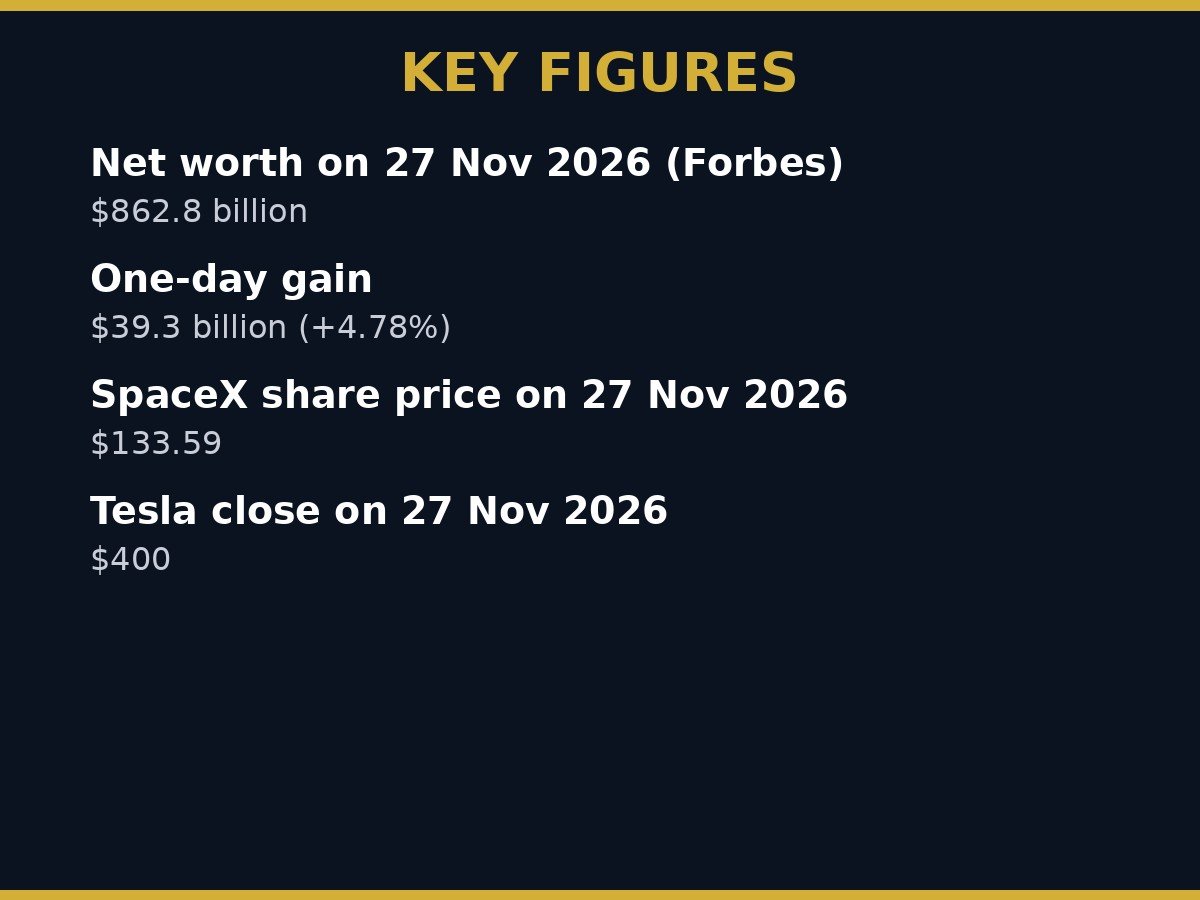
| Net worth on 27 November 2026 | $862.8 billion (Forbes, real-time) |
| One-day gain | $39.3 billion (+4.78%) |
| Net worth on 26 November 2026 | $823.5 billion (Forbes, real-time) |
| SpaceX share price, 27 November | $133.59, up 4.83% |
| Tesla close, 27 November | $400, up 5.22% |
| Net worth on 1 November 2026 | $869 billion (Forbes monthly list) |

What happened on 27 November
Elon Musk gains $39 billion in the space of a single trading day, and the scale of the move is hard to overstate. A gain of $39.3 billion is larger than the entire fortune of most billionaires on the Forbes list, yet for Musk it arrived as a single line on a real-time tracker. Forbes recorded his net worth at $862.8 billion on 27 November, up from $823.5 billion the day before. The rise of 4.78 percent was his biggest one-day gain since 23 November, and it came at the end of a week that had already delivered both a heavy loss and a strong recovery.
The move was driven by SpaceX, the rocket and satellite company Musk founded, rather than by Tesla, the electric vehicle maker most people associate with his wealth. SpaceX shares rose 7.47 percent overnight on the Blue Ocean ATS platform, a venue where shares of private companies can change hands outside normal market hours. By 4:20 a.m. ET on 27 November, SpaceX stock was trading at $133.30, up 4.60 percent from Wednesday's close of $127.44. Shares had already closed 1.30 percent higher on Wednesday, so the momentum was building before the holiday-shortened Friday session even began.
In Friday's shortened session, the gains kept coming. Tesla closed at $400, up 5.22 percent, while SpaceX rose a further 4.83 percent to $133.59. With both of his largest holdings up around five percent on the same day, a fortune as large as Musk's moves by tens of billions of dollars.
Why SpaceX shares moved so fast
Private company shares do not trade the way public stocks do. There is no continuous market with millions of buyers and sellers setting a price every second. Instead, SpaceX shares change hands in private transactions and on alternative trading platforms, and each new trade can reset the implied value of the whole company. That structure explains why a single day can bring a jump of more than seven percent overnight: a small number of trades at higher prices can lift the valuation of every share Musk holds.
Two pieces of news gave buyers a reason to pay up, and both arrived within days of each other, which helped the buying build into a single sharp move rather than a slow drift. The first was a pledge from Musk himself to give SpaceX shares to American children every year. The second was a regulatory approval that opens a huge new market for SpaceX. Together, they changed the story investors were telling about the company, from a rocket business with an impressive launch record to a company with a credible path into space-based data centres. When the story changes, the price follows, and because Musk owns such a large stake, his fortune follows with it.
The satellite approval that changed the story
On Wednesday, SpaceX won approval from United States regulators to deploy one million satellites for data centres in space. The scale of the number is what caught the market's attention. One million satellites is far beyond anything in orbit today, and it signals that regulators are willing to let SpaceX build infrastructure in space at a scale no rival can match.
Data centres in space sound like science fiction, but the logic is straightforward. Space offers abundant solar energy and natural cooling, two of the biggest costs for data centres on Earth. If SpaceX can place computing capacity in orbit, it would open a market that does not exist today, and the company that controls the launches would have a natural advantage in building it. The approval does not guarantee the business will work, and building a million satellites would take years and cost an enormous sum. Markets, however, price in possibilities, not certainties, and the approval removed a major obstacle. That is why the shares moved: the range of what SpaceX might become suddenly looked wider, and buyers were willing to pay for that wider range.
A pledge to American children
The second driver of the rally was a pledge from Musk to give SpaceX shares to American children every year. The promise was reported as a factor behind the overnight jump, and it matters for two reasons. First, it signals confidence from the founder himself: a chief executive does not promise to hand out shares every year unless he believes the company will keep growing in value. Second, it puts SpaceX in front of a much wider audience, turning a private rocket company into a household name for families who might never have followed the space industry.
Whether the pledge will be repeated every year, and how many shares it will involve, remains unclear. What is clear is that it arrived at exactly the right moment to add momentum to a rally already under way. News of the pledge and news of the satellite approval landed within the same short window, and together they gave buyers two reasons to bid the price higher.
Tesla's part in the rebound
Tesla played a supporting role in the day's gains, and it was an important one. The carmaker closed at $400 on Friday, up 5.22 percent in the shortened session, and when Tesla rises it lifts the mood across the market, which helped SpaceX shares too. Tesla was once the dominant part of Musk's fortune, but SpaceX has grown in value while Tesla's share price has swung up and down, so the rocket company now carries more weight in his net worth.
From a $63.8 billion slide to a $39.3 billion gain
The gain looks even larger when set against what happened just two days earlier. Musk had led Wednesday's losses among the world's billionaires, down as much as $63.8 billion at one point during the day. His fortune stood at $823.5 billion on 26 November, after a slide that wiped out more than the entire net worth of most of the world's richest people. The speed of the fall was matched only by the speed of the recovery.
That whiplash is the defining feature of Musk's fortune in November 2026. Forbes' monthly list on 1 November had put him at $869 billion, down $68 billion in October alone. The annual Forbes list in March 2026 had valued him at $839 billion. Between those markers, his wealth has swung by tens of billions of dollars in single days. The numbers are snapshots, not fixed facts, and the difference between one day and the next is a change in what investors believe those companies will be worth in the years ahead.
Readers who want the longer view can look back at our earlier coverage of Elon Musk's fortune falling to $817 billion earlier in November, which shows how sharp the swings have been all month. The broader picture is in our report on tech billionaires losing $273 billion in November, and for contrast, see how Warren Buffett gained $13 billion in November 2026. For the latest billionaire rankings, see the Forbes real-time billionaires list, the Bloomberg Billionaires Index, Reuters, and CNBC.

Why SpaceX now drives most of Musk's fortune
SpaceX is now the largest part of Musk's fortune, and understanding why explains why his net worth moves in such big steps. The company is private, which means its value is set by occasional transactions rather than by a daily public market. When a new trade happens at a higher price, the value of Musk's entire holding jumps at once. Public companies move in small daily steps; private companies can move in leaps, and those leaps show up directly in the Forbes tracker.
The company's value rests on three businesses that reinforce each other. Its rockets launch satellites and carry cargo and astronauts. Its Starlink network sells internet service from those satellites to millions of customers. And now, with the approval for a million satellites, it has a path into space-based data centres. That combination is why investors are willing to pay more for SpaceX shares even though the company does not publish the kind of detailed financial reports that public companies must. As long as that story holds, Musk's fortune will keep moving in large steps, up as well as down.
What comes next
The immediate question is whether the rally can hold. SpaceX shares rose on news, and news-driven rallies can fade if the next piece of news disappoints. The satellite approval is a long-term opportunity, not a short-term source of revenue, and building a million satellites will take years. The pledge to American children is a promise about the future, not a completed transaction. Both are reasons for optimism, but neither puts cash in the company's bank account tomorrow.
The longer-term question is whether SpaceX can keep growing fast enough to justify its rising valuation. The company has done it before, turning a small rocket startup into the world's dominant launch provider. Its next challenge is bigger: building a satellite network and a space-based computing business at a scale nobody has attempted. For now, Elon Musk gains $39 billion in a day stands as the headline of the week, and it is a reminder of how concentrated the world's largest fortune has become.
Frequently Asked Questions
How much did Elon Musk gain in one day?
Elon Musk gains $39 billion in a single day, with Forbes recording a rise of $39.3 billion, or 4.78 percent, on 27 November 2026. His fortune reached $862.8 billion, up from $823.5 billion the day before, making it his biggest one-day gain since 23 November. All figures are estimates from Forbes' real-time tracker and move daily with share prices.
Why did SpaceX shares rise so sharply?
SpaceX shares rose 7.47 percent overnight on the Blue Ocean ATS platform, reaching $133.30 by 4:20 a.m. ET on 27 November and closing at $133.59. Two pieces of news drove the move: Musk's pledge to give SpaceX shares to American children every year, and US approval for SpaceX to deploy one million satellites for data centres in space. Tesla also rose 5.22 percent to $400, adding to the gain.
How much did Elon Musk lose earlier in the week?
Musk led Wednesday's losses among billionaires, falling by as much as $63.8 billion at one point during the day. His fortune stood at $823.5 billion on 26 November, after a slide that wiped out more than most billionaires are worth in total. The $39.3 billion gain on Friday recovered part of that loss, though not all of it.
Is SpaceX now worth more to Musk than Tesla?
SpaceX is now the largest part of Musk's fortune, which is why his net worth moves in such big steps. Because SpaceX is private, its value is set by occasional trades rather than a daily public market, so a new trade at a higher price can lift the value of his whole stake at once. Tesla remains a major holding and still adds billions on a strong day, but the rocket company now carries more weight in the Forbes calculation.