Jensen Huang falls out of the top 10 richest people in the world as Nvidia shares plunge and a board investigation into his personal life wipes billions off his fortune in a matter of days. The Nvidia co-founder lost $7.4 billion in the first 30 minutes of trading on 9 November 2026, then a further $8.4 billion the next day, sliding from eighth to 12th on Forbes' real-time billionaires list.
It is a fall with two causes, and they arrived in the same week. The first was political: Nvidia shares dropped 9.26% on 5 November 2026 after the US midterm results raised worries about new AI regulation. The second was personal: on 8 November, Nvidia's board announced an independent investigation into reports about Huang's relationship with a Chinese businesswoman whom US officials reportedly suspected of espionage links. Together, the two shocks turned the world's most valuable chipmaker into the market's biggest story.
At a Glance
| Detail | Figure as reported |
|---|---|
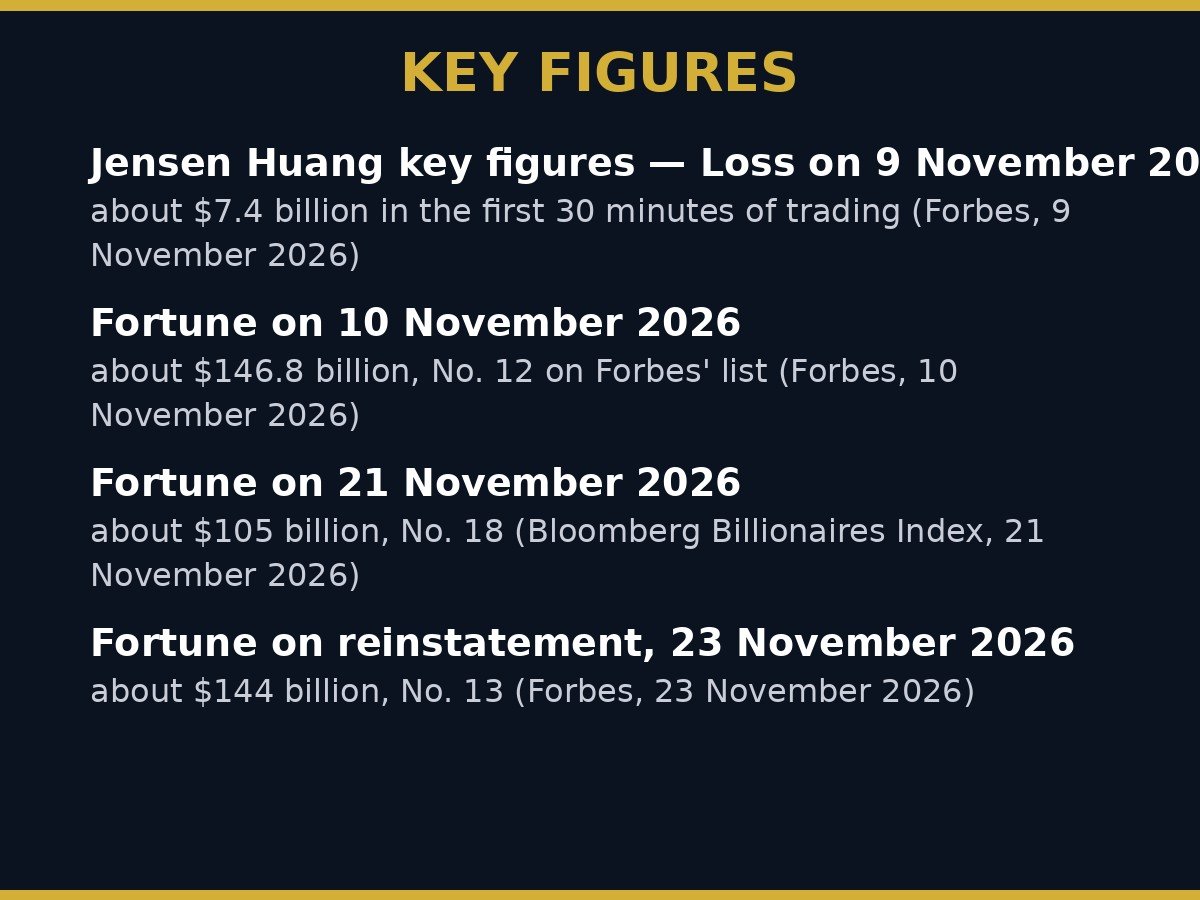
| Fortune on 2 October 2026 | About $204.5 billion (Forbes) |
| Fortune on 9 November 2026 | About $155.4 billion (Forbes) |
| Loss in the first 30 minutes of 9 November | About $7.4 billion, from $162.2 billion to $154.7 billion |
| Loss on 10 November 2026 | About $8.4 billion, to about $146.8 billion |
| Rank after 10 November | No. 12 on Forbes' Real-Time Billionaires list |
| Rank before the slide | No. 8 in the world |
| Nvidia shares on 5 November 2026 | Down 9.26% after the US midterm results |
| Nvidia market capitalisation peak | About $5.7 trillion on 2 October 2026 |
| Nvidia market capitalisation on 10 November | About $4.06 trillion |
| Fortune on 21 November 2026 | About $105 billion, No. 18 (Bloomberg Billionaires Index) |
| Huang's Nvidia stake | About 3.5% of the company, around 870 million shares |
| Fortune on reinstatement, 23 November | About $144 billion, No. 13 (Forbes) |
How Jensen Huang Falls Out of the Top 10
The collapse began before the scandal broke. On Thursday 5 November 2026, Nvidia shares fell 9.26% — their steepest one-day decline since January 2025 — after the US midterm results delivered big gains for Democrats and raised investor fears that restrictions on data-centre development and AI regulation could weaken demand for AI chips. Huang, who had been ranked ninth on the Bloomberg Billionaires Index before that session, lost more than $15 billion in a single day, according to Forbes reporting.
Then came the weekend. On Sunday 8 November, Nvidia's board announced an independent investigation into reports about Huang's relationship with Alice Huang, a businesswoman US officials reportedly suspected of espionage links, and Huang admitted to employees that he had been unfaithful to his wife.
When markets opened on Monday 9 November, the reaction was immediate. Nvidia shares opened more than 7% lower, briefly wiping $10.3 billion off Huang's fortune and pushing him out of the world's top ten altogether. By the end of the first 30 minutes of trading, his fortune had fallen by $7.4 billion, from $162.2 billion to $154.7 billion, according to Forbes — and he had slipped two places, from eighth to tenth, falling below Berkshire Hathaway's Warren Buffett and Oracle's Larry Ellison. He was the only person among the world's ten richest billionaires to lose money that day.
Tuesday was worse. Nvidia shares fell a further 5.6% by late morning, and Huang lost about $8.4 billion more, taking his fortune to about $146.8 billion and his ranking to No. 12 — down four places in two days. In two trading sessions, he had lost about $16 billion. Forbes' live billionaires tracker updates its estimates daily, and the gap between Huang and the top ten has kept moving with the share price ever since.
The 5 November Sell-Off: Midterms Spook AI Investors
The first blow had nothing to do with Huang personally. The US midterm elections on 3 November 2026 produced strong results for Democrats, and investors read them as a warning for the AI industry. Tighter rules on where data centres can be built, and on how AI chips can be sold and used, would hit Nvidia first — it makes the chips that power almost all of the world's AI systems.
For Huang, the timing could not have been worse. His fortune had stood at about $204.5 billion on 2 October 2026, when Nvidia's market value peaked at about $5.7 trillion. By the morning of 10 November, Nvidia's market capitalisation had fallen to about $4.06 trillion — a loss of roughly $1.6 trillion in value in five weeks. Huang owns about 3.5% of the company, around 870 million shares, so every percentage point off the share price costs him billions.
The Investigation: What Nvidia's Board Announced
The second blow was the one that made the story global. The controversy followed a report by The New York Times that US intelligence agencies had assessed that Huang had a close relationship with Alice Huang, a Chinese citizen whom US authorities suspected of collecting information for Beijing. According to the report, US intelligence believed she had been recruited to gather information on Huang for China's Ministry of State Security. Those claims have not been independently established, and Nvidia has said it had no reason to believe national security or its confidential information had been compromised. The inquiry is led by the law firm Wachtell Lipton, overseen by a committee of independent directors.
The market, however, does not wait for investigations to conclude. Investors sold Nvidia shares because they feared a leadership crisis at the company that sits at the centre of the AI boom — and because the affair raised questions about chip shipments to China. US authorities have been investigating the company's possible role in China's access to Nvidia chips since 2024, and Republican lawmakers sought a congressional briefing on the matter.
From $204.5 Billion to $105 Billion: The Slide in Numbers
The speed of the decline is what makes it remarkable. On 2 October 2026, Forbes put Huang's fortune at about $204.5 billion. By 9 November it was about $155.4 billion. By 12 November, the day he resigned, Bloomberg put it at $138.4 billion and Forbes at $144.7 billion. And by Friday 21 November, the Bloomberg Billionaires Index had him at about $105 billion, ranked 18th in the world — with Gautam Adani, at about $121 billion, having overtaken him.
The comparisons put the scale in perspective. Mark Zuckerberg's fortune stood at about $220 billion in November 2026, more than double Huang's by the end of the month, and Gautam Adani, the man who overtook him, had been far behind Huang only weeks earlier.
Yet the structure of the loss matters. Like Ellison at Oracle, Huang's wealth is almost entirely one holding: his Nvidia stake, built over the 33 years since he co-founded the company in 1993, is the overwhelming source of his fortune. When the shares fall 30% from their peak, the fortune falls with them — whatever the reason for the fall.
Resignation, Then a $34 Billion Comeback
The crisis peaked on Thursday 12 November 2026, when Huang resigned as Nvidia's president, chief executive officer and a director, with immediate effect, ending more than three decades at the helm. Huang lost about $8.2 billion on resignation day alone, according to Forbes.
Eleven days later, the story turned again. On 23 November, Nvidia's board voted unanimously to reinstate Huang as chief executive, president and a director, and the shares surged about 31% in a single session. His fortune jumped by about $33.9 billion in a day, to about $144 billion, according to Forbes — recovering about two-thirds of the $52.1 billion he had lost since 9 November. He climbed five places to 13th on Forbes' ranking.
The comeback did not last the week. By Tuesday morning, Nvidia shares had fallen 8% again, and Forbes put his fortune at $133.1 billion by 10:50 a.m. in New York — more than $10 billion of the comeback gain unwound in a morning. The investigation is continuing, and Huang is set to appear before multiple congressional committees. Readers who followed Jensen Huang's $33 billion gain saw the same whiplash in real time: a fortune that can rise $34 billion in a day can fall almost as fast the next.
What to Watch Next
Three things will decide where Huang lands next. The first is the board's investigation: its findings, and whether they lead to any further action, will set the tone for the shares. The second is the political pressure: export controls on AI chips, congressional hearings, and the wider US crackdown on data centres in South-East Asia suspected of funnelling computing power to China. The third is Nvidia's own business: whether demand for its AI chips is holding up through the turmoil.
For now, Huang remains one of the richest people alive — about $133 billion is still an almost unimaginable sum — but he is out of the top ten, and the path back runs through questions no spreadsheet can answer.
All figures in this article are dated estimates from the sources named, and they change in real time as markets move. They are not financial advice, and they should not be used as the basis for any investment decision.
Frequently Asked Questions
How much did Jensen Huang lose in November 2026?
Jensen Huang falls out of the top 10 after losing about $16 billion in two trading sessions, 9 and 10 November 2026 — $7.4 billion in the first 30 minutes of trading on 9 November, and about $8.4 billion more on 10 November, according to Forbes. His fortune fell from about $204.5 billion on 2 October to about $105 billion by 21 November, according to the Bloomberg Billionaires Index.
Why did Nvidia shares fall in November 2026?
Nvidia shares fell for two reasons in the same week. First, the US midterm results on 3 November raised fears of tighter AI regulation and data-centre restrictions, and the shares dropped 9.26% on 5 November. Second, on 8 November Nvidia's board announced an independent investigation into reports about Jensen Huang's relationship with a businesswoman US officials reportedly suspected of espionage links, and the shares fell sharply when markets opened on 9 November.
What is the Nvidia investigation into Jensen Huang about?
On 8 November 2026, Nvidia's board announced an independent investigation, led by the law firm Wachtell Lipton, into reports about Huang's relationship with Alice Huang, a former executive at Singapore-based Megaspeed International whom US officials reportedly suspected of gathering information for Beijing. Huang admitted in a message to employees that he had been unfaithful to his wife and said he supported the investigation.
Is Jensen Huang still the CEO of Nvidia?
Yes. Huang resigned on 12 November 2026, but Nvidia's board voted unanimously to reinstate him on 23 November, and the shares surged about 31% that day. His fortune jumped by about $33.9 billion to about $144 billion, according to Forbes, but he remained outside the world's top ten richest people, ranked 13th.