The Carl Icahn fortune collapses to about $1.3 billion, the lowest level since the Bloomberg Billionaires Index began tracking his wealth in 2012. The 90-year-old activist investor touched just $1.2 billion on Friday 20 November 2026 before a small rebound in his company's units lifted him back to roughly $1.3 billion on Monday, according to Bloomberg reporting published on 24 November 2026.
It is a staggering fall for a man once worth $26.1 billion and ranked among the 25 richest people in the world. Almost all of his remaining wealth is tied to Icahn Enterprises, the holding company he controls, whose units have lost 64% of their value in 2026. The company has warned it may not be able to refinance $1.4 billion of bonds due in May 2027, while Icahn owes about $1.3 billion in personal loans secured by those same units.
At a Glance
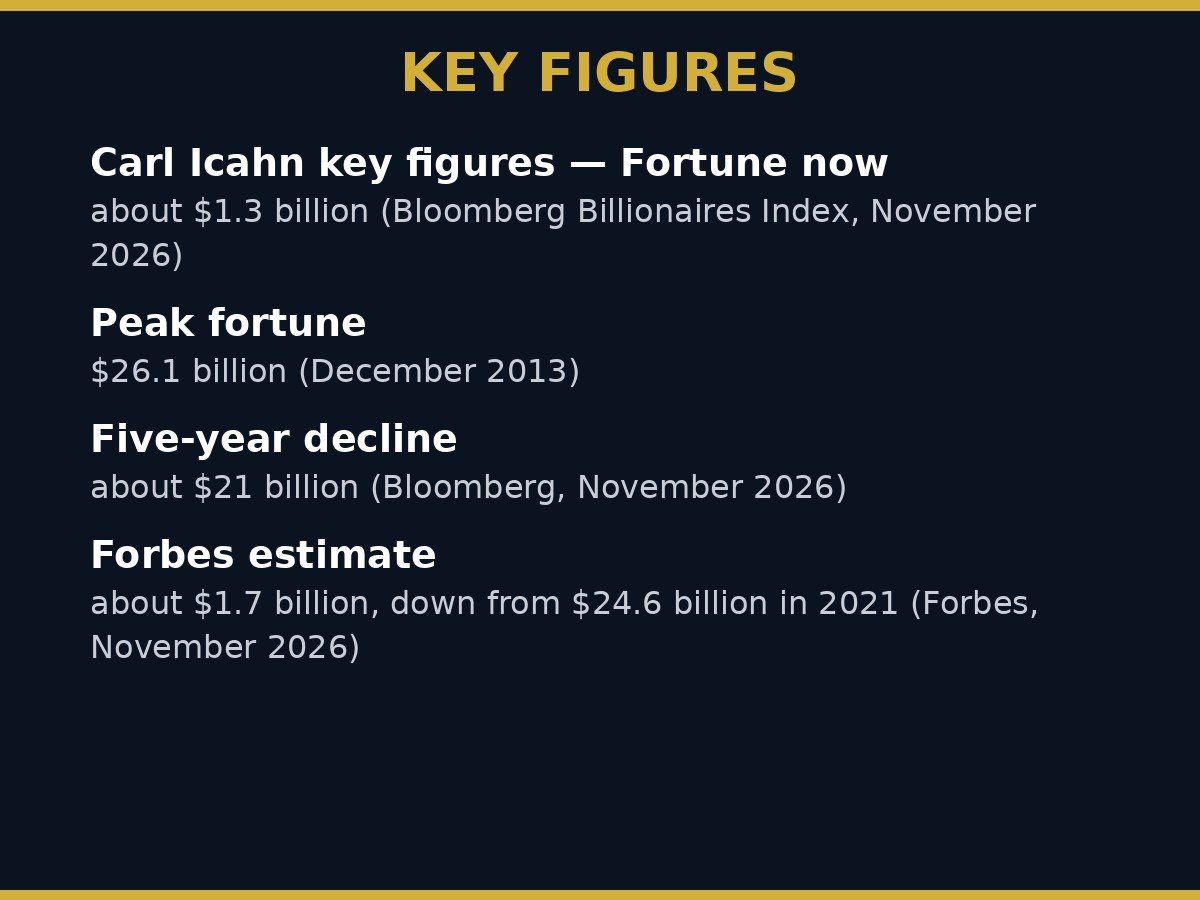
| Detail | Figure as reported |
|---|---|
| Fortune now | About $1.3 billion (Bloomberg Billionaires Index, November 2026) |
| Lowest point | About $1.2 billion on Friday 20 November 2026 |
| Lowest since | Bloomberg began tracking his fortune in 2012 |
| Peak fortune | $26.1 billion in December 2013 |
| Forbes estimate | About $1.7 billion, down from $24.6 billion in 2021 |
| Five-year decline | About $21 billion, per Bloomberg |
| Icahn Enterprises units in 2026 | Down 64%, including 56% this quarter |
| IEP unit price | $2.73 at the close on Tuesday 24 November 2026 |
| Bonds due May 2027 | $1.4 billion of 5.25% notes due 15 May 2027 |
| Icahn's personal loans | About $1.3 billion, secured by IEP units |
| Investment funds in 2026 | Down 43.8% through 30 September 2026 |
How the Carl Icahn Fortune Collapses to $1.3 Billion
The collapse did not happen in a single day, but the final leg was brutally fast. IEP units have fallen 56% this quarter and 64% in 2026, closing at $2.73 on Tuesday 24 November 2026 after another 8.4% single-day drop. Because Icahn and his affiliates own about 87% of the units, his fortune moves almost exactly with the unit price — and the units have fallen by more than 40% this month.
Friday 20 November 2026 was the worst moment: the Bloomberg Billionaires Index put his fortune at about $1.2 billion, the lowest since it began tracking him in 2012. A rebound of roughly 6% to 7% in IEP units on Monday added about $100 million, lifting the estimate back to about $1.3 billion. Celebrity Net Worth's account of the collapse puts the decline at 95% from the peak and notes he is now only about $300 million from losing his billionaire status.
Why Icahn Enterprises Units Fell So Fast
The immediate cause is concentration. Icahn Enterprises is a diversified holding company, but its value is dominated by a few holdings, above all the oil refiner CVR Energy, in which it owns most of the shares. CVR makes up roughly half of IEP's value, and its shares have tumbled about 40% since it agreed early in November 2026 to buy two refineries for about $4.2 billion, funded partly with $2.5 billion of new debt.
The deal landed on top of grim results: a third-quarter net loss of $225 million, against net income of $287 million a year earlier, and investment funds down 31% in the quarter on refining hedges meant to offset the CVR stake. The funds were down about 43.8% for 2026 through 30 September, and have posted only one positive full year since the end of 2018.
The $1.4 Billion Refinancing Deadline
Behind the share price sits a harder problem: debt. Icahn Enterprises has about $4.4 billion of bonds outstanding, and $1.4 billion of 5.25% notes fall due on 15 May 2027. In its third-quarter report, the company warned there "can be no assurance" it will be able to refinance those notes on acceptable terms — or at all.
The bond market has priced in the danger: yields on the May 2027 notes have risen above 14%, up from about 6% three months ago, and yields on some 2029 bonds now exceed 30% — the borrowing costs of a company the market fears may not pay in full.
The company is not without resources: it ended September 2026 with roughly $920 million in cash and about $1.4 billion in fund interests it says can be redeemed on notice, and it has pursued asset sales including Pep Boys for around $700 million. But the cash alone does not cover the May maturity.
The Personal Loans: $1.3 Billion Borrowed Against the Stake
The most alarming detail is a coincidence of numbers: Icahn's personal loans stand at about $1.3 billion, almost exactly his entire remaining fortune. The loans are secured by his IEP units, and nearly all of his holding is pledged — about 658.9 million units at the end of September 2026.
The borrowing first drew wide attention in May 2023, when short seller Hindenburg Research argued Icahn Enterprises was overvalued and its distributions unsustainable, and highlighted how much Icahn had borrowed against his stake. In August 2024, Icahn and the company paid a combined $2 million to settle US Securities and Exchange Commission charges that the loans had not been properly disclosed, without admitting or denying the findings.
Icahn has restructured the loans since then, extending them to July 2028 in August 2025 and paying down about $300 million. Even so, the maths is unforgiving: if the unit price falls much further, the loans start to look larger than the fortune they are secured against.
From $26.1 Billion to $1.3 Billion: The Five-Year Slide
To understand how far Icahn has fallen, it helps to remember how he made the money. He built his reputation in the 1980s as a corporate raider, taking large stakes in companies such as TWA and Texaco and forcing changes that enriched shareholders — and himself. He later won a long, public battle with Bill Ackman over Herbalife: his total profit from Herbalife has been estimated at about $1.3 billion, while Ackman's losses approached $1 billion. The irony is hard to miss — that famous profit is now roughly equal to Icahn's entire remaining fortune.
The peak came in December 2013, when his fortune reached $26.1 billion. His investment funds lost money in seven of the nine years from 2014 through 2022, largely because of large short positions betting against a stock market that kept rising. The Hindenburg report of May 2023 cut his net worth from $18.3 billion to $12 billion in a single day, and IEP units have fallen about 86% since that report.
Forbes, which uses a different method, puts his fortune at about $1.7 billion — down from $24.6 billion in 2021, a fall of roughly 93%. See Forbes' profile of Carl Icahn.
What the Two Trackers Disagree On — and Why It Matters
Bloomberg says about $1.3 billion. Forbes says about $1.7 billion. The $400 million gap is not a mistake; it reflects different methods. Bloomberg values Icahn's IEP stake at the market price of the units and deducts his personal loans, while Forbes applies its own adjustments to the value of his holdings and debts. Both agree on the essentials: the fortune has collapsed by more than 90% from its peak, and it is falling fast.
The disagreement matters because it decides how close Icahn is to losing his billionaire status. On Bloomberg's figure, he is about $300 million above the line; on Forbes' figure, he has about $700 million of headroom. Either way, a further sharp fall in IEP units could push him below $1 billion. Forbes' live billionaires tracker updates its estimates daily, so the gap between the two figures will keep moving with the unit price.
The lesson is one this site has covered before: when almost all of a person's wealth sits in a single listed holding, the net worth figure is really just the share price multiplied by the stake. Readers who followed Larry Ellison's $10.9 billion one-day loss saw the same maths — a 7.5% fall in Oracle shares cost Ellison more than most billionaires own. Diversified fortunes, like that of Warren Buffett, spread across dozens of businesses, do not swing this violently.
What to Watch Next
Three things will decide where Icahn lands next. The first is the May 2027 refinancing: whether Icahn Enterprises can roll over $1.4 billion of notes, and at what cost, will set the tone for the units. The second is CVR Energy, roughly half of IEP's value — its share price, and whether the two-refinery purchase pays off, matters more than anything else in the portfolio. The third is the loans themselves: if the unit price falls far enough, lenders may demand more collateral, and Icahn has little left to pledge.
There is also the question of the distribution. Icahn Enterprises has cut its quarterly payout twice since the Hindenburg report, from $2.00 per unit to $1.00 in August 2023 and to $0.50 in November 2024. Most of it is now paid in new units rather than cash, and each new unit dilutes the holders who came before. Michael Bloomberg's own fortune, built on a private company that never had to pay a public distribution, shows how different the maths looks without that pressure.
For now, the man who spent forty years exposing weaknesses in other people's businesses faces the most serious test of his own: his fortune is down about $21 billion in five years, and his loans roughly equal everything he has left.
All figures in this article are dated estimates from the sources named, and they change in real time as markets move. They are not financial advice, and they should not be used as the basis for any investment decision.
Frequently Asked Questions
How much is Carl Icahn worth now?
Carl Icahn is worth about $1.3 billion according to the Bloomberg Billionaires Index, as reported in November 2026 — the lowest figure since Bloomberg began tracking his fortune in 2012. Forbes puts his fortune slightly higher, at about $1.7 billion. Both trackers agree he has lost more than 90% of his peak fortune of $26.1 billion, reached in December 2013.
Why did Carl Icahn's fortune collapse?
The Carl Icahn fortune collapses because almost all of his wealth is tied to Icahn Enterprises, whose units have fallen 64% in 2026. The holding company's value is dominated by the refiner CVR Energy, whose shares fell about 40% after a deal to buy two refineries, and its funds lost 43.8% through September 2026. The company also warned it may not refinance $1.4 billion of bonds due in May 2027.
How much does Carl Icahn owe in personal loans?
Icahn owes about $1.3 billion in personal loans, according to the Bloomberg Billionaires Index — roughly the same as his entire remaining fortune. The loans are secured by his Icahn Enterprises units, and nearly all of his holding is pledged as collateral. He extended the loans to July 2028 and paid down about $300 million in August 2025, but the borrowing remains the central risk to his finances.
Is Carl Icahn still a billionaire?
Yes, but only just. On Bloomberg's estimate of about $1.3 billion, he is roughly $300 million above the billionaire line; on Forbes' estimate of about $1.7 billion, he has more headroom. A further sharp fall in Icahn Enterprises units could push him below $1 billion. His fortune is now less than one-twentieth of its 2013 peak.