Michael Dell loses $68 billion in just over six weeks, the largest dollar fall among the world's ten richest people in that stretch. Forbes' real-time estimates put his fortune at about $266 billion on 2 October 2026 and about $198 billion on 17 November 2026, a drop that pushed him from fourth to sixth in the world.
The slide tracks Dell Technologies shares almost tick for tick. The stock that briefly made him the second-richest person on the planet in September has fallen more than 40% from its peak as investors question how long the AI hardware boom can last.
At a Glance
| Detail | Figure as reported |
|---|---|
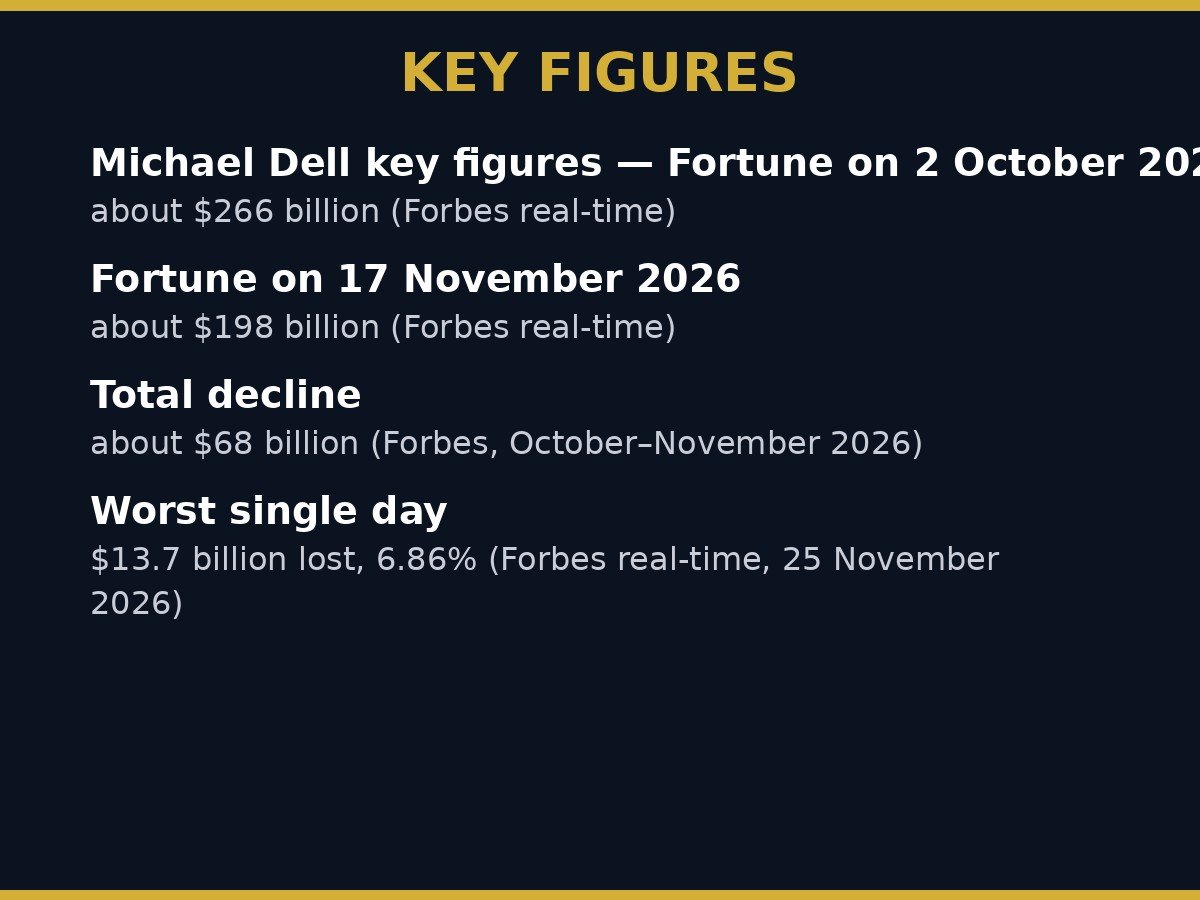
| Fortune on 2 October 2026 | About $266 billion (Forbes real-time) |
| Fortune on 17 November 2026 | About $198 billion (Forbes real-time) |
| Total decline | About $68 billion in six weeks |
| Rank change | From No. 4 to No. 6 in the world |
| Largest dollar fall | Biggest among the top 10 in the period |
| Peak fortune | Above $280 billion in October 2026 |
| Worst single day | $13.7 billion lost on 25 November 2026 (6.86%) |
| Dell share price | Record high about $596 in October 2026, about $278 by 20 November 2026 |
| Dell stake | About 40% of Dell Technologies |
| Family office | DFO Management, with holdings in hotels, real estate, credit and Broadcom |
| Third-quarter revenue | $54.94 billion, up 103% year on year (Dell, 24 November 2026) |
| AI server backlog | A record $132.3 billion (Dell, 24 November 2026) |
How Michael Dell Loses $68 Billion in Six Weeks
The maths behind the fall is brutally simple. Michael Dell owns roughly 40% of Dell Technologies, and almost all of his fortune is tied to that single holding. When Dell shares fall, his net worth falls with them, multiplied by the size of his stake. A 10% drop costs him roughly $20 billion, and a 40% drop costs him roughly $68 billion — which is almost exactly what happened.
Forbes' real-time tracker captured every step. On 1 October 2026 it valued Dell at about $268 billion, fourth in the world. By 1 November the figure was about $229 billion, still fourth. By 11 November Bloomberg had him at about $212 billion and sixth, and on 17 November Forbes put him at about $198 billion, sixth in the world, behind Musk, Bezos, Page, Brin and Zuckerberg. Forbes' live billionaires tracker updates these estimates daily, so the figures keep moving with the share price.
The October Peak: Past $280 Billion on AI Server Demand
To understand the fall, it helps to remember the climb. Dell Technologies spent 2026 riding the biggest infrastructure boom in its history, as companies building AI data centres ordered servers and storage in quantities nobody had seen before. In September 2026 the shares closed at a record $588.40, and Dell briefly became the second-richest person in the world. His fortune passed $280 billion in October 2026, according to Forbes' real-time estimates.
The orders kept coming. In the fiscal third quarter alone the company booked $60.2 billion of new AI server orders and ended the quarter with a record $132.3 billion AI backlog, according to the results Dell reported on 24 November 2026. Revenue reached $54.94 billion, more than double a year earlier, and AI-optimised server revenue rose 291% to $22.03 billion.
Three Blows in Five Weeks
The first blow came on 14 October 2026, when Barclays downgraded Dell Technologies from overweight to equal-weight, questioning demand from businesses for AI systems. The shares closed down 11.27% that day and fell more than 9% the next morning. Forbes cut Dell's net worth by about $35 billion over the two sessions, the first big chunk of the $68 billion he would lose by mid-November. AI hardware stocks had risen so fast in 2026 that any hint of slowing demand hit them hard, and Dell's shares were up more than 130% since the start of the year.
The second blow landed on 4 November 2026, the day after the United States midterm elections. Dell Technologies shares fell more than 9% as investors worried that the results — Democrats taking control of Congress — could bring tighter limits on data-centre projects and tougher regulation of the AI sector. Dell's fortune fell $12.3 billion in a single day, the biggest one-day drop of any billionaire that day except Elon Musk. The same session produced a changing of the guard: Meta chief Mark Zuckerberg gained about $3 billion and overtook Dell to become the world's fifth-richest person, with about $216.6 billion against Dell's $212.5 billion, according to Forbes' real-time estimates. Forbes' account of the day notes that Dell's $212.5 billion marked a 5.5% drop, while a second Forbes report puts his fortune at around $206 billion after the nearly 9% slide.
The third blow was the worst week of the slide. By 13 November Dell shares had fallen about 41% from their September record, closing at $344.53. Then on Friday 20 November 2026, Dell's net worth plunged by more than $16 billion in a single day, according to Bloomberg data, leaving him worth more than $176 billion as Dell stock fell to its lowest level since May. By that Friday the shares had dropped from a record high of about $596 in October to about $278, and Dell's fortune was down more than $88 billion from its peak this year, according to Bloomberg's figures.
Record Earnings, Falling Shares: The 24 November Paradox
Dell reported its fiscal third-quarter results after the market closed on Tuesday 24 November 2026, and the numbers were extraordinary by any measure. Revenue of $54.94 billion was more than double a year earlier and the highest in the company's history. Adjusted earnings per share came in at $9.45, well above the $6.55 analysts expected. AI server revenue rose 291% to $22.03 billion, the company booked $60.2 billion of new AI orders, and it raised its full-year revenue forecast to $202 billion from $192 billion, while authorising a $25 billion share buyback.
The market sold the stock anyway. Dell shares had already closed down about 12% at around $295 on Tuesday, among the S&P 500's worst performers, before the results came out — dragged down by rival Hewlett Packard Enterprise, whose shares fell about 16% after warning that memory shortages could last into 2028 and that its cloud and AI margins would shrink. Then on Tuesday 25 November, Dell lost $13.7 billion in a single session — 6.86% of his fortune, the second-largest single-day drop of any billionaire that day after Elon Musk. Four billionaires — Musk, Dell, Jensen Huang and Larry Ellison — lost a combined $65.3 billion in that one session, according to Forbes' real-time list, and Dell's fortune fell to about $186.3 billion.
Why One Man's Fortune Moves With One Share Price
The reason Dell's fortune swings so violently is concentration. He owns roughly 40% of Dell Technologies, where he is chairman and chief executive, and that stake dominates his wealth. The rest sits in his family office, DFO Management, which holds hotels, real estate, credit investments and a stake in Broadcom — but those holdings are small beside the Dell stake. When the shares fall 40%, his fortune falls by tens of billions. When they rise 10%, he gains $18 billion in a day. Forbes' profile of Michael Dell sets out the same picture: a fortune built on the Dell stake, with the family office holdings alongside it.
The same maths explains why other fortunes in the top ten have been steadier. Readers who followed Warren Buffett's $13 billion gain in November saw the opposite pattern: Berkshire Hathaway spreads its value across dozens of businesses, so no single share price decides Buffett's fortune. Jensen Huang, whose wealth is tied to Nvidia, has swung the same way Dell has Concentration cuts both ways: it made Dell the second-richest person in the world in September, and it cost him $68 billion by November.
Dell founded the company in his University of Texas dorm room in 1984, took it private in a $25 billion buyout with Silver Lake in 2013, and built the modern Dell Technologies through the $60 billion EMC merger in 2016, which brought VMware into the group and turned a PC maker into an infrastructure giant.
What the $68 Billion Loss Means — and What to Watch
The $68 billion fall has reshuffled the top of the rich list. Dell entered October at No. 4 and now sits at No. 6, behind Musk, Bezos, Page, Brin and Zuckerberg. It also tells a wider story about 2026: the year's biggest fortunes were built on AI, and November was the month the market started asking whether AI spending can pay for itself. Our report on the tech billionaires who lost $273 billion in November puts Dell's fall in that wider context: the same boom that created the fortunes is now testing them.
For Dell himself, the loss changes little: he remains the sixth-richest person in the world, and his company has never sold more. The $68 billion is a paper loss, not a cash one. Three things will decide where he lands next: the fourth quarter, where Dell has guided to $56.3 billion of revenue and adjusted earnings of $8.40 per share; memory prices, with Dell reportedly seeking increases of 25% to 45% on some contracted orders; and the wider AI trade itself. Elon Musk's own $817 billion November fall shows the same pattern at an even larger scale. In a year when fortunes are made and lost on the price of a single stock, $68 billion can disappear in six weeks — and $18 billion of it can come back in a single day.
All figures in this article are dated estimates from the sources named, and they change in real time as markets move. They are not financial advice, and they should not be used as the basis for any investment decision.
Frequently Asked Questions
How much did Michael Dell lose in November 2026?
Michael Dell loses $68 billion between 2 October and 17 November 2026, according to Forbes' real-time estimates — from about $266 billion to about $198 billion. It was the largest dollar fall among the world's ten richest people over those dates.
Why did Michael Dell's fortune fall so fast?
The fall happened because Dell owns roughly 40% of Dell Technologies, so his fortune moves with the share price. Dell shares fell more than 40% from their September record as investors worried that AI hardware spending would slow and that memory shortages would squeeze margins. A Barclays downgrade on 14 October and post-election worries on 4 November were the two sharpest triggers.
What is Michael Dell worth now?
Forbes' real-time list put Michael Dell at about $198 billion on 17 November 2026, sixth in the world. The figure moves daily with Dell Technologies shares: it fell to about $176 billion on 20 November, recovered to $200.1 billion on 23 November, and dropped to about $186.3 billion on 25 November after a $13.7 billion single-day fall.
Will Michael Dell recover the $68 billion?
Nobody can say for certain, because his fortune is tied to one share price. The business case for a recovery is strong — record revenue, a $132.3 billion AI backlog and a raised full-year forecast — but the market's worry is about margins and the sustainability of AI spending, not about demand. If Dell shares return to their October highs, his fortune would rise back above $280 billion.