
The Jeff Bezos Blue Origin valuation has transformed the Amazon founder's fortune in 2026, with outside investors pricing his rocket company at $130 billion before new money and about $140 billion after it. Forbes' real-time tracker put Bezos at $374.4 billion on 23 November 2026, making him the second-richest person in the world, and the jump from a year earlier is largely a paper gain on a company he funded alone for a quarter of a century.
Bezos founded Blue Origin in 2000 and paid for it himself for 26 years, selling Amazon shares to keep the rockets flying. In July 2026 that changed: the company opened its first outside funding round, seeking $10 billion at a $130 billion pre-money valuation, with Coatue Management expected to lead with about $4 billion and Bezos himself putting in another $2 billion. The round turned a private passion project into one of the most valuable private space companies in the world.
At a Glance
| Detail | Figure as reported |
|---|---|
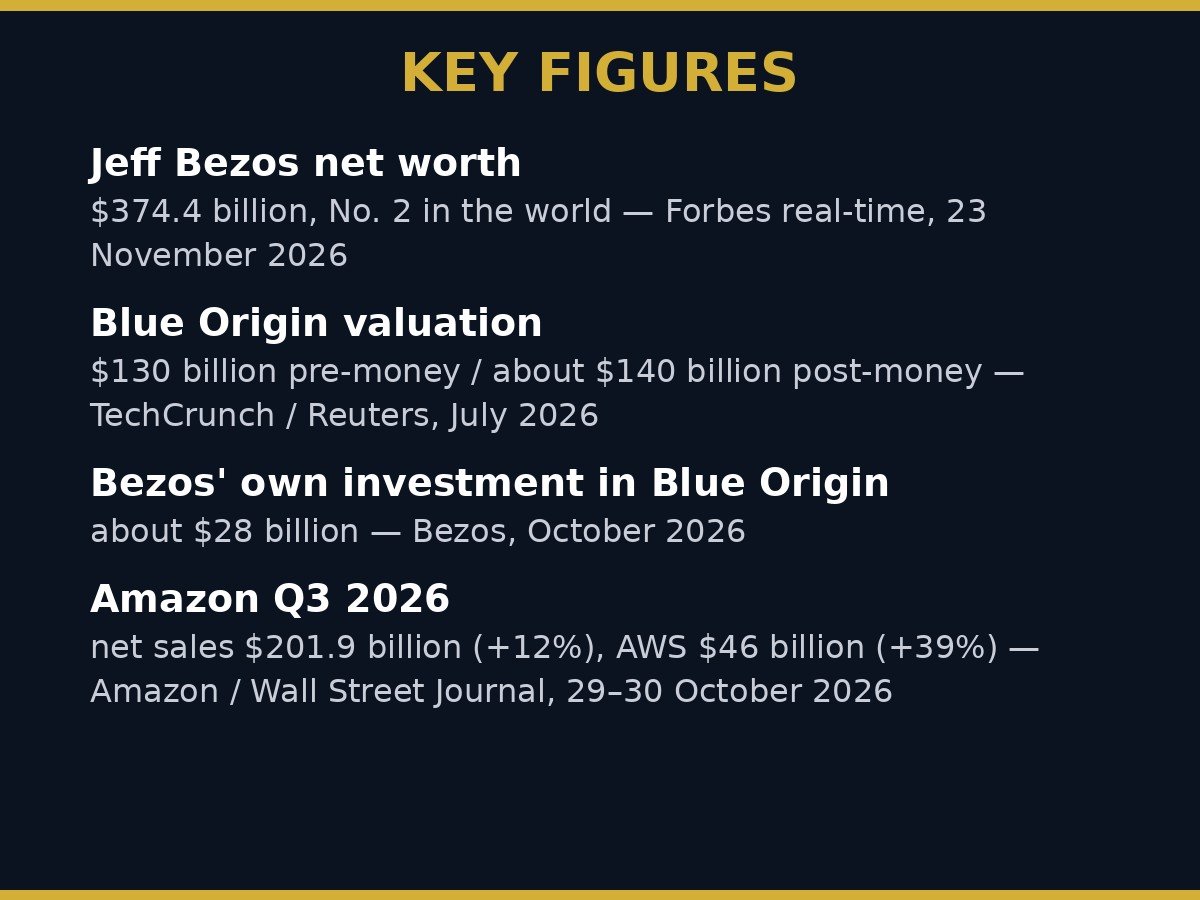
| Net worth | $374.4 billion (Forbes real-time, 23 November 2026); No. 2 in the world |
| Forbes monthly figure | $361 billion on 1 November 2026, down $8 billion in the month |
| Blue Origin pre-money valuation | $130 billion (reported July 2026) |
| Blue Origin post-money valuation | About $140 billion after the $10 billion raise |
| Size of the round | $10 billion, Blue Origin's first outside funding |
| Lead investor | Coatue Management, about $4 billion; Bezos about $2 billion |
| Bezos' own money in Blue Origin | About $28 billion, by his own account in October 2026 |
| Amazon stake | About 8% of Amazon (about 879 million shares held directly) |
| Amazon Q3 2026 | Net sales $201.9 billion, up 12%; AWS $46 billion, up 39% |
| Project Prometheus | AI startup; $12 billion raised at a $41 billion valuation, June 2026 |
| Amazon market value | Passed $3 trillion on 3 August 2026 |
Jeff Bezos Blue Origin Valuation: The $130 Billion Revaluation
Blue Origin spent its first 26 years as a one-man project. Bezos founded the company in September 2000, about eighteen months before Elon Musk started SpaceX, and funded it almost entirely himself, mostly by selling Amazon shares. He told Fox News in October 2026 that he had personally put about $28 billion into the company, while the Wall Street Journal reported in September 2026 that the total including the new round was about $30 billion.
The July 2026 round changed that overnight — and the Jeff Bezos Blue Origin valuation was set. TechCrunch's report on the Blue Origin funding round described the company raising $10 billion at a $130 billion pre-money valuation, citing the New York Times, with Coatue Asset Management expected to invest about $4 billion and Bezos himself committing $2 billion. Reuters' report on the Blue Origin raise confirmed the same figures, and the Wall Street Journal later reported in September 2026 that the $10 billion had been raised at a valuation of about $140 billion once the new money was counted.
The timing mattered. Investor appetite for space companies surged after SpaceX's record initial public offering, which raised about $86 billion and gave SpaceX a public-market valuation of about $1.75 trillion, according to Reuters. Blue Origin is a very different business from SpaceX — it has no satellite internet arm to match Starlink, it still trails far behind on launch cadence and revenue, and its New Glenn heavy-lift rocket was destroyed in a ground-test explosion in May 2026 — but the market's enthusiasm for space lifted every company in the sector. At $130 billion, Blue Origin is worth more than many listed aerospace firms, including Lockheed Martin, whose market capitalisation sits near $121.7 billion.
Why the Estimates Disagree by More Than $80 Billion
Here is the puzzle at the heart of the Jeff Bezos Blue Origin valuation: the published estimates of his net worth now disagree by more than $80 billion, and almost all of the gap comes down to Blue Origin. Forbes put him at $374.4 billion on 23 November 2026 and at $366.8 billion on 21 November, ranking him second in the world. Bloomberg's Billionaires Index, by contrast, put him at about $283 billion on 12 November 2026, ranking him fourth. The difference is not about Amazon, whose share price both trackers can see. It is about how to value a private rocket company that has never been traded on a stock market.
Forbes counts the Jeff Bezos Blue Origin valuation at the $130 billion set by the new investors; Bloomberg values it at roughly what Bezos has invested in it — the cost method — which produces a far smaller number. Neither can be checked against a market price, because Blue Origin is privately held. One independent estimate put his fortune at about $325 billion, in a range of $280 billion to $370 billion depending on the Blue Origin value.
The gap is a reminder that billionaire fortunes built on private companies are far less certain than fortunes built on listed shares — and the Jeff Bezos Blue Origin valuation is the reason why. Amazon's price is visible every second the market is open; Blue Origin's price is whatever the last group of investors agreed to pay. Until Blue Origin lists its shares — Bezos said in October 2026 that an IPO could make sense several years from now — every estimate of his wealth will carry a Blue Origin-sized margin of error.
Amazon Still Pays the Bills
Amazon remains the foundation of Bezos' fortune. He owns about 8% of the company, with about 879 million shares held directly after stock gifts in November 2026. Amazon's third-quarter results, announced on 29 October 2026, showed why: net sales rose 12% to $201.9 billion, and Amazon Web Services, the cloud division, grew 39% to $46 billion, its fastest growth in nearly five years. Operating income reached $28.1 billion, a record margin of 13.9%, and net income was $20.7 billion.
The results were not all good news for shareholders. The Wall Street Journal's report on Amazon's third-quarter earnings noted that overall revenue of $201.9 billion and net income of $20.7 billion both came in below analysts' estimates, and Amazon shares fell about 7.3% in after-hours trading. The company also disclosed capital spending of $75.9 billion in the quarter and plans to spend $220 billion on capital expenditure this year, largely to build AI data centres — the bill behind AWS's fast growth, and the reason investors are nervous about the returns.
Amazon passed another milestone earlier in the year, when its market value crossed $3 trillion on 3 August 2026. Bezos has also been selling shares on a steady plan: his current share-sale plan covers up to 15 million Amazon shares and runs until 26 February 2027, and the proceeds have funded Blue Origin for years. He has also been giving shares away: Forbes Middle East reported in November 2026 that he donated nearly $200 million in Amazon shares to nonprofits, and estimated his net worth at $376.7 billion at that point, second in the world behind Elon Musk. For context on the world's richest person, read our Elon Musk net worth profile.
Project Prometheus: Bezos's New AI Bet
The second private company behind the surge is one most people had never heard of until this year. Project Prometheus is an industrial AI startup that Bezos co-leads as co-chief executive alongside Vik Bajaj, the former chief scientific officer of Verily — his first chief executive role since leaving Amazon's top job in 2021. The company is building what its founders call an artificial general engineer: AI that accelerates the design and manufacturing of physical products.
Prometheus raised $12 billion in a Series B funding round in June 2026 at a valuation of about $41 billion, according to Axios, and Forbes estimates that Bezos holds about a 20% stake, worth roughly $8.2 billion at that valuation. The company employs only about 150 people and has not yet demonstrated a commercial product or announced a paying customer, which makes the valuation striking: investors are paying for the idea and the team, led by one of the most successful founders in history, rather than for revenue.
The startup also signals a change in Bezos himself. After stepping back from Amazon's day-to-day operations, he is now running a company again, and one in the field every big technology firm is racing to dominate. Whether Prometheus justifies its $41 billion valuation will take years to find out, but its effect on his fortune is already visible: Forbes credited the September surge in his wealth — about $102 billion in a single month to early October 2026 — largely to the new private-market values placed on Blue Origin and Prometheus.
What to Watch Next
Three things will decide where the Jeff Bezos Blue Origin valuation goes from here. The first is Blue Origin's rockets: New Glenn needs to fly reliably, and the planned TeraWave satellite network and Project Sunrise constellation of AI data-centre satellites need to move from plans to revenue. The second is Amazon's AI spending, with AWS growing 39% but a $220 billion capital expenditure bill behind it.
The third is the ranking itself: Bezos sits second in the world on Forbes' figures, far behind Elon Musk at roughly $877 billion, but fourth on Bloomberg's figures — and that gap is entirely about the Jeff Bezos Blue Origin valuation. The tech billionaires' $273 billion November slide shows how quickly even the biggest fortunes can move in a single month. For contrasting fortunes built on diversified public holdings, see our Warren Buffett net worth profile and our Mark Zuckerberg net worth profile. Forbes' profile of Jeff Bezos carries the current real-time figure, and the full background is in our Jeff Bezos net worth profile.
All figures in this article are dated estimates from the sources named, and they change in real time as markets move. They are not financial advice, and they should not be used as the basis for any investment decision.
Frequently Asked Questions
How much is Jeff Bezos worth in November 2026?
Forbes' real-time tracker put Jeff Bezos at $374.4 billion on 23 November 2026, ranking him the second-richest person in the world — a figure driven by the Jeff Bezos Blue Origin valuation. Bloomberg's Billionaires Index put him lower, at about $283 billion on 12 November 2026, because it values Blue Origin differently.
What is the Jeff Bezos Blue Origin valuation?
The Jeff Bezos Blue Origin valuation is $130 billion before new money in its first outside funding round in July 2026, or about $140 billion after the $10 billion raise. The round was led by Coatue Management with about $4 billion, with Bezos himself contributing about $2 billion. Forbes counts Blue Origin at $130 billion in its estimate of Bezos' fortune.
Why do Forbes and Bloomberg disagree about Jeff Bezos' net worth?
The gap comes almost entirely from the Jeff Bezos Blue Origin valuation. Forbes values the rocket company at the $130 billion price set by its new investors, while Bloomberg values it at roughly what Bezos has invested in it, about $28 billion. Because Blue Origin is privately held and its shares do not trade, neither figure can be checked against a market price.
What is Project Prometheus?
Project Prometheus is an AI startup co-led by Jeff Bezos as co-chief executive alongside Vik Bajaj. It is building AI systems to speed up the design and manufacturing of physical products. It raised $12 billion in June 2026 at a valuation of about $41 billion, and Forbes estimates Bezos holds about a 20% stake, worth roughly $8.2 billion.